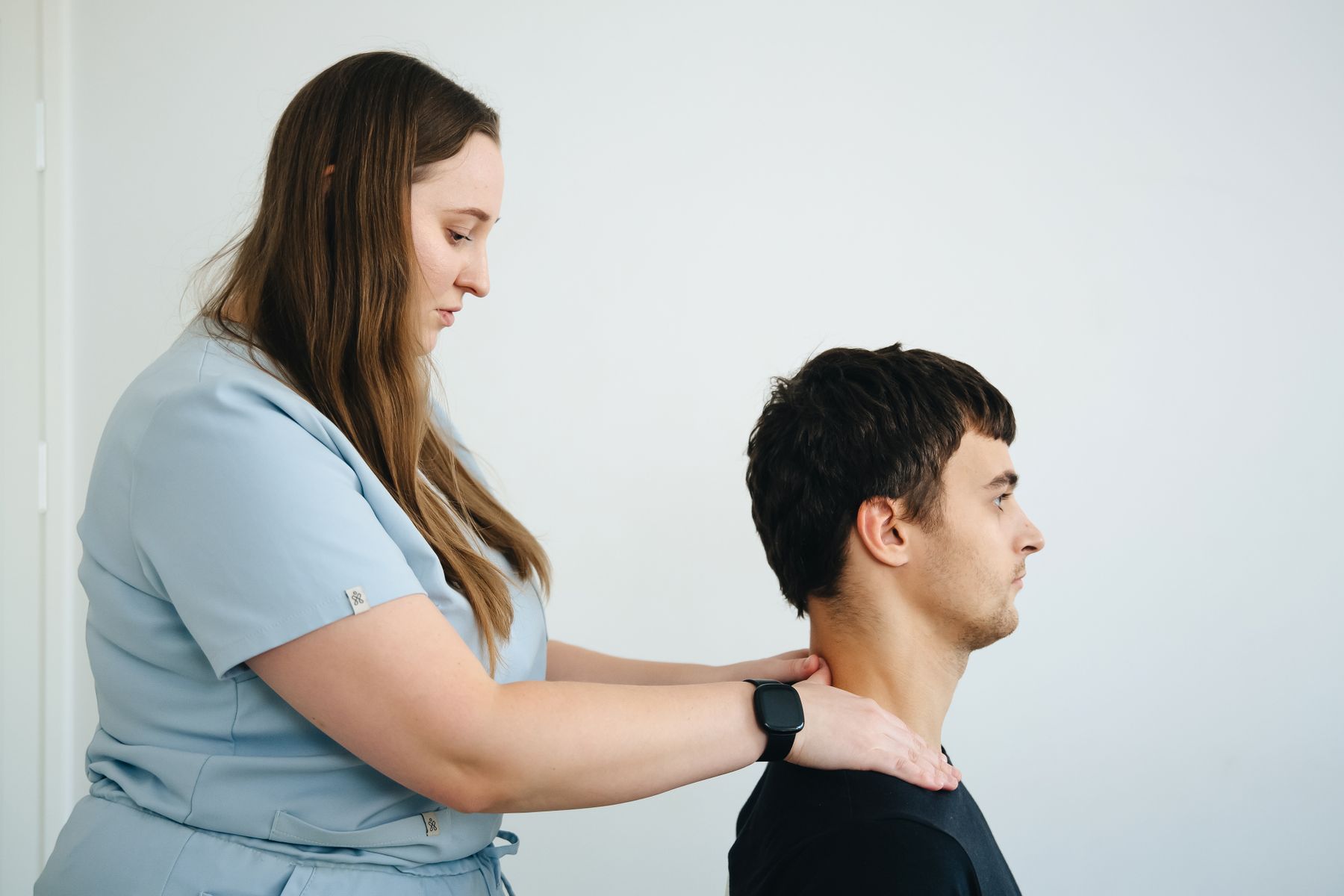
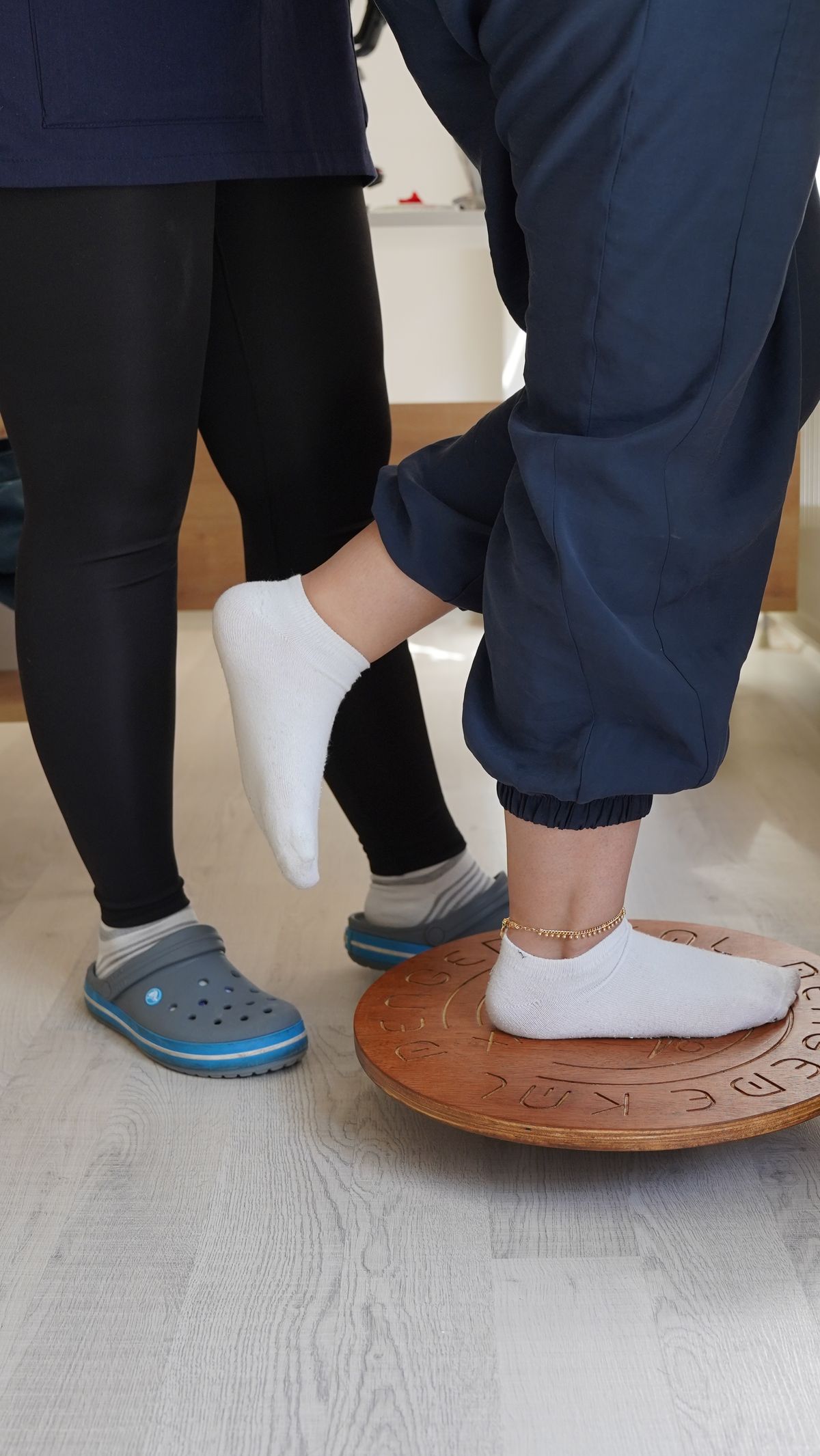
Whiplash is a neck injury from rapid back-and-forth head motion — most often a rear-end collision — causing pain, stiffness, headaches, and sometimes dizziness. The evidence favors early, active movement over collars and rest, and structured exercise over passive treatment. RISE Physical Therapy treats whiplash one-on-one in 45-minute sessions in Boise and Nampa, Idaho, with no referral required.
What is whiplash?
Whiplash is an acceleration-deceleration injury of the neck: the head whips backward and forward faster than the neck muscles can brace, straining joints, muscles, ligaments, and the deep stabilizing system that controls head position. Rear-end vehicle collisions are the classic cause — including low-speed ones, since cabin speed change, not bumper damage, is what the neck experiences — but sports collisions and falls produce the same injury.
Clinicians grade the result as whiplash-associated disorder (WAD) grades 0–4, from no complaints through neck complaints with signs, to fracture or dislocation. Most people fall in grades 1–2 — real pain and restricted motion without structural damage — which is precisely the group where active rehabilitation has the most to offer.
Symptoms: when should you seek help?
Whiplash symptoms often arrive on a delay, peaking a day or two after the collision. Book an evaluation if you notice:
Neck pain and stiffness that started within days of a collision or impact
Headaches climbing from the base of the skull
Pain spreading to the shoulders or between the shoulder blades
Dizziness, visual strain, or trouble concentrating
Tingling or heaviness in an arm
Seek urgent medical care first — before rehab — for severe midline neck tenderness, weakness or numbness in the arms or legs, difficulty walking, or an inability to rotate the neck at all after a high-speed crash; these trigger imaging under the Canadian C-Spine Rule.
Whiplash symptoms often peak a day or two after the collision — early assessment sets the recovery course.
What does the research say about whiplash treatment?
Three findings shape modern whiplash care. First, for acute whiplash, active management beats immobilization: a systematic review and meta-analysis of conservative treatment for acute WAD found active interventions superior to collars and rest for pain and recovery.[1] Second, exercise helps: a 2021 systematic review and meta-analysis concluded exercise therapy improves pain and disability in whiplash-associated disorders, while noting the evidence base remains modest in quality.[2]
Third — and this one is refreshingly honest — more is not automatically better. In the PROMISE randomized trial of 172 patients with chronic whiplash published in The Lancet, a 20-session comprehensive exercise program was no more effective than a single advice session with phone follow-up.[3] The lesson isn't that treatment is pointless; it's that quality beats quantity. Well-taught active care, confidence-building, and a clear plan appear to carry most of the benefit — which is why our model is focused coaching toward independence, not open-ended visit counts.
How we treat whiplash at RISE
Whiplash care at RISE starts with a careful screen and ends with a neck you trust again — on a visit count that respects the evidence. Every session is 45 minutes one-on-one with the same Doctor of Physical Therapy.
Safety screening first: validated rules and a neurological exam make sure rehab is appropriate — and route you to imaging when it isn't yet.
Early, graded movement: tolerable range-of-motion work and daily-life strategies from the first visit, replacing the collar-and-wait approach.
Deep neck and scapular retraining: the stabilizing muscles that switch off after injury get switched back on and strengthened.
Headache and dizziness care: manual therapy for the upper neck — see our headache and migraine guide — plus vestibular and concussion screening when the collision shook more than the neck.
Rule-based safety screening, motion and strength testing, and a check for headache, dizziness, and concussion overlap.
02 — TREAT
Restore movement early
Graded motion, manual therapy, and pain-management strategies get the neck moving in the window that matters most.
03 — REBUILD
Rebuild strength and confidence
Deep neck flexor and scapular strengthening, endurance work, and a return to driving, work, and sport without guarding.
What to expect at your first visit
Your story first. The collision details, when symptoms appeared, what's hardest now — driving, sleeping, screens — and any headache, dizziness, or arm symptoms.
A safety and neuro screen. Canadian C-Spine Rule criteria, reflexes, sensation, and strength — if imaging is warranted, we coordinate it before proceeding.
A movement and headache exam. Neck motion, deep stabilizer function, upper-neck joint assessment, and vestibular screening when dizziness is in the picture.
Treatment on day one. Gentle range work, manual therapy as tolerated, and the first exercises of your home program — plus what's normal and what's not this week.
A recovery map. Clear milestones and a planned endpoint: the goal is your independence, not indefinite visits.
Frequently asked questions
How soon after a car accident should I start physical therapy for whiplash?+
Once serious injury has been ruled out, early is better — evidence for acute whiplash favors staying active and beginning gentle, structured movement within the first days to weeks rather than resting in a collar.[1] Early activity is associated with better recovery than immobilization, and it also gives you a coach for the flare-ups and worries that are normal in the first month.
Do I need an X-ray or MRI after whiplash?+
Not always. Clinicians use validated rules — such as the Canadian C-Spine Rule — to decide who needs imaging after a collision; many people with whiplash have no fracture or instability and don't need X-rays. Red flags like severe midline bone tenderness, neurological deficits, or a high-risk mechanism warrant imaging before rehab begins, and that screening is part of the first visit.
Should I wear a neck collar for whiplash?+
Generally no. Soft collars encourage the neck to stiffen and the supporting muscles to switch off, and comparative studies favor active movement over immobilization for whiplash recovery.[1] Outside of specific medical instructions after serious injury, the modern approach is the opposite of a collar: keep the neck moving within tolerable limits, early and often.
Why do I have headaches and dizziness after whiplash?+
The upper neck joints and muscles refer pain to the head — the classic whiplash headache starts at the skull base — and the neck's position sensors, which help coordinate balance and eye movement, can be disrupted by the injury. Both usually improve as the neck recovers. Dizziness deserves specific assessment, since collisions can also involve concussion or inner-ear problems — see our vestibular & concussion guide — which we screen for and treat.
Do I need a referral for whiplash treatment in Idaho?+
No. Idaho is a direct-access state, so you can book a whiplash evaluation at RISE without a physician referral. Some insurance plans — commonly Medicare, Medicaid, and Tricare — require a referral for coverage, and we'll verify your plan's requirements before your first visit. If your care involves an auto insurance claim, bring your claim information and we'll help you navigate the paperwork.
Does insurance cover physical therapy for whiplash?+
Most major medical plans cover physical therapy for whiplash, and care after a collision is often covered through auto insurance medical payments or personal injury protection. RISE is in-network with most major insurance plans in Idaho — check our insurance list or contact us and we'll verify your coverage before your first appointment.
Devon is a co-founder of RISE Physical Therapy and treats orthopedic, sports, post-surgical, concussion, and TMJ injuries. He earned his Doctorate of Physical Therapy at Idaho State University. Meet the full team →
SOURCES
Wiangkham T, et al. The Effectiveness of Conservative Management for Acute Whiplash Associated Disorder (WAD) II: A Systematic Review and Meta-analysis of Randomised Controlled Trials. PLOS One, 2015. ncbi.nlm.nih.gov/pmc/articles/PMC4511004
Chrcanovic B, et al. Exercise Therapy for Whiplash-Associated Disorders: A Systematic Review and Meta-analysis. Scandinavian Journal of Pain, 2021. pubmed.ncbi.nlm.nih.gov/34561976
Michaleff ZA, et al. Comprehensive Physiotherapy Exercise Programme or Advice for Chronic Whiplash (PROMISE): A Pragmatic Randomised Controlled Trial. The Lancet, 2014. pubmed.ncbi.nlm.nih.gov/24703832
 Medically reviewed by Dr. Devon Hoffman, PT, DPT, CSCS · August 2026