Dizziness is not something to wait out. Vestibular rehabilitation retrains the balance system after concussion, vertigo, and inner-ear problems — one-on-one, with a clear path back to work, school, and sport.
Vestibular rehabilitation is exercise-based therapy that retrains the brain’s balance and gaze systems after concussion, vertigo (including BPPV), and other inner-ear disorders. Research shows it reduces dizziness and can shorten time to return-to-sport after concussion. RISE Physical Therapy provides one-on-one, 45-minute vestibular and concussion rehab sessions in Boise and Nampa, Idaho — no referral required.
What is vestibular rehabilitation?
Vestibular rehabilitation therapy (VRT) is a specialized, exercise-based treatment that retrains how your brain uses signals from the inner ear, the eyes, and the body to keep you balanced and visually stable. When that system is disrupted — by a concussion, an inner-ear problem, or loose crystals in the ear canals (BPPV) — the result is dizziness, vertigo, fogginess, and a world that seems to move when it shouldn't.
The balance system is trainable at any age. VRT uses precisely dosed gaze, head-movement, and balance exercises to push the system just hard enough that the brain recalibrates — the same principle as strength training, applied to your equilibrium.
Symptoms: when should you seek help?
Concussion symptoms typically resolve within 7–10 days — but dizziness, vertigo, and balance problems persist in an estimated 10–30% of cases, and those are exactly the cases vestibular rehab is built for.[1] Get evaluated if you have:
Dizziness or fogginess lasting more than a couple of weeks after a head injury
Brief, intense spinning when you roll over in bed or look up (classic BPPV)
Headaches, nausea, or fatigue triggered by head movement or reading
An athlete stuck in limbo — "cleared" of red flags but clearly not ready to play
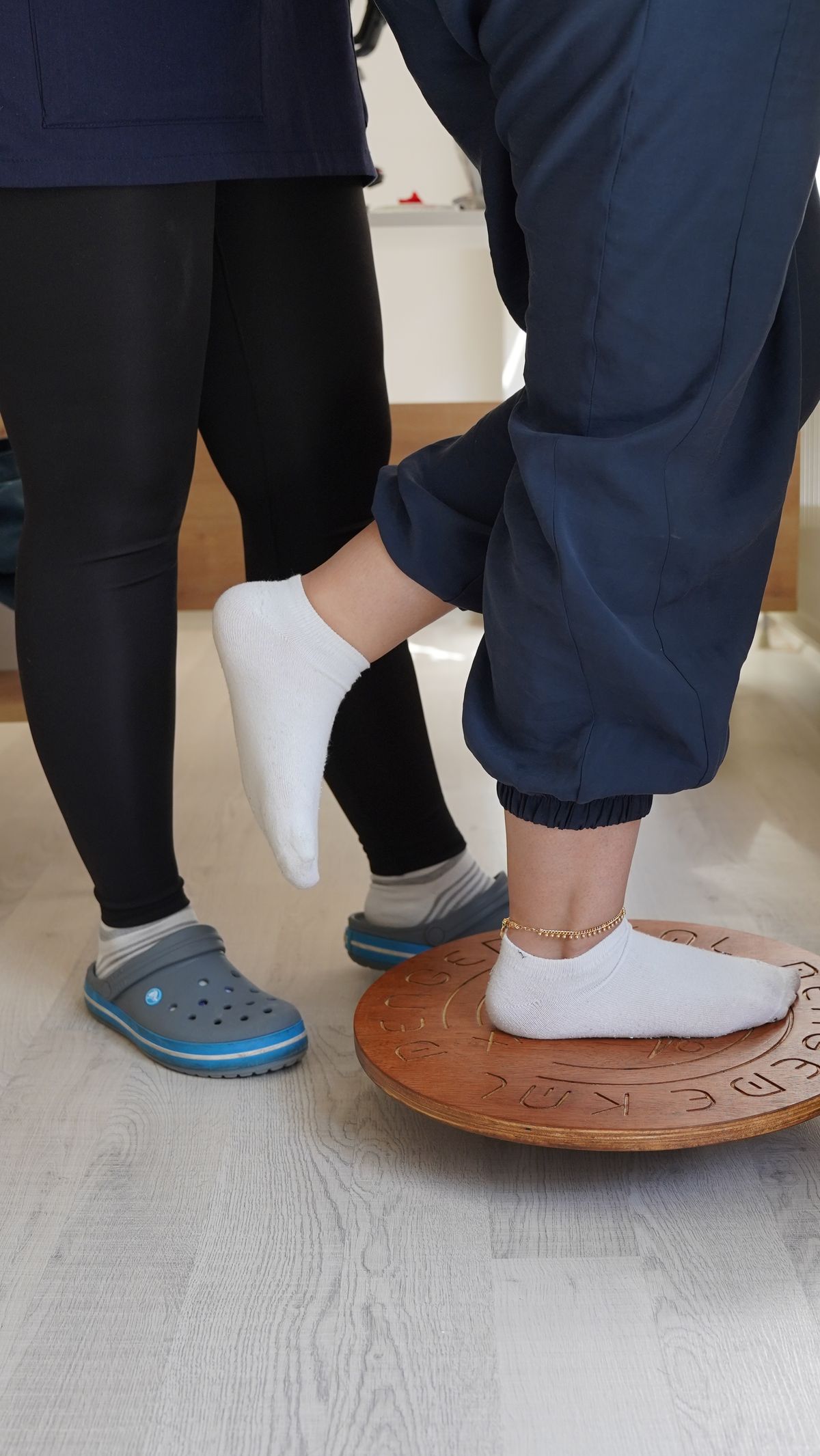
Balance retraining is progressive: stable to unstable surfaces, still head to moving head, quiet room to busy environment.
What does the research say?
Vestibular rehabilitation is one of the better-supported tools in post-concussion care. A systematic review of randomized controlled trials found VRT effective in reducing dizziness after concussion, and in the acute phase it reduced time to return-to-sport.[2] Reviews of early intervention in athletes report most symptoms improving within 6–12 weeks of starting treatment.[1] For BPPV specifically, repositioning maneuvers (like the Epley maneuver) resolve the spinning for most patients in a small number of visits — often one to three.
Just as important: dizziness that lingers is rarely "just anxiety" or something to white-knuckle through. It is usually a treatable, mechanical or neurological problem with a well-mapped rehab pathway.
How we treat dizziness & concussion at RISE
Vestibular problems are detective work, and detective work takes time — which is exactly what a 45-minute one-on-one session provides. Your evaluation sorts out which system is driving your symptoms, because BPPV, visual-vestibular mismatch, neck involvement, and exertion intolerance each need different treatment.
Oculomotor and gaze testing: we assess how your eyes track, fixate, and stabilize during head movement — the core of post-concussion visual symptoms.
Positional testing for BPPV: if crystals in the inner ear are the culprit, a repositioning maneuver often changes everything within a few visits.
Balance and gait assessment: quantified, so progress is measured rather than guessed.
Neck evaluation: whiplash and concussion travel together; stiff, guarded neck tissue can drive both dizziness and headache.
Graded return-to-activity plan: for athletes, a stepwise exertion progression toward full clearance — not just "rest and see."
Gaze, position, balance, neck, and exertion testing pinpoint what’s actually producing your dizziness.
02 — TREAT
Recalibrate
Repositioning maneuvers, gaze stabilization, and balance retraining — dosed to challenge without flaring you.
03 — REBUILD
Return with confidence
Graded return to work, screens, driving, and sport, with objective criteria at each step.
What to expect at your first visit
A full history. The injury or onset, what triggers symptoms, what your day looks like, and any red flags that need medical referral.
System-by-system testing. Eyes, inner ear, balance, neck, and — for athletes — exertion response. You’ll know which one is driving symptoms.
Treatment starts day one. If BPPV is found, repositioning often begins immediately; otherwise you’ll leave with your first calibrated exercises.
A written progression. What to do daily, what to avoid for now, and what milestones unlock the next step.
Coordination when needed. We communicate with physicians, athletic trainers, and schools for return-to-learn and return-to-play decisions.
Frequently asked questions
How soon after a concussion should I start vestibular therapy?+
Earlier than most people think. After an initial short rest period (typically 24–48 hours), guided, symptom-limited activity outperforms strict rest — and research on athletes shows early vestibular rehab can shorten time to return-to-sport. If dizziness persists beyond two weeks, an evaluation is clearly warranted.
What is BPPV, and can you really fix it in a few visits?+
Benign paroxysmal positional vertigo happens when tiny crystals in the inner ear shift into a canal where they don’t belong, causing brief intense spinning with position changes. Repositioning maneuvers like the Epley guide the crystals back — and for most patients the vertigo resolves within one to three visits.
Do I need a brain scan before starting?+
Usually not. Concussion is a functional injury that generally doesn’t appear on CT or MRI, and imaging is reserved for red-flag symptoms. We screen for those at your evaluation and refer you to a physician immediately if anything warrants it.
Do I need a referral for vestibular rehab in Idaho?+
No. Idaho allows direct access to physical therapy, so you can book an evaluation at RISE without a physician referral. Some plans (Medicare, Medicaid, Tricare) require one for coverage — call us and we’ll verify your insurance before your first visit.
Can I keep exercising while I recover?+
In most cases yes — at the right dose. Complete rest beyond the first couple of days tends to prolong symptoms. We build a graded exertion plan that keeps you moving below your symptom threshold and progresses as your system recalibrates.
How long does vestibular rehab take to work?+
BPPV often resolves in 1–3 visits. Post-concussion vestibular symptoms typically improve over 6–12 weeks of progressive rehab, though timelines vary with how long symptoms have persisted and whether the neck or visual system is involved.
Does insurance cover vestibular and concussion rehab?+
Most major medical plans cover vestibular physical therapy. RISE is in-network with most major insurance plans in Idaho — contact us with your plan details and we’ll verify coverage before you’re ever charged.
Devon is a co-founder of RISE Physical Therapy and treats concussion, TMJ, headache, orthopedic, and sports injuries. He earned his Doctorate of Physical Therapy at Idaho State University. Meet the full team →
SOURCES
Can vestibular rehabilitation exercises help patients with concussion? A systematic review of efficacy, prescription and progression patterns. Br J Sports Med, 2017. pubmed.ncbi.nlm.nih.gov/27655831/
 Medically reviewed by Dr. Devon Hoffman, PT, DPT, CSCS · August 2026