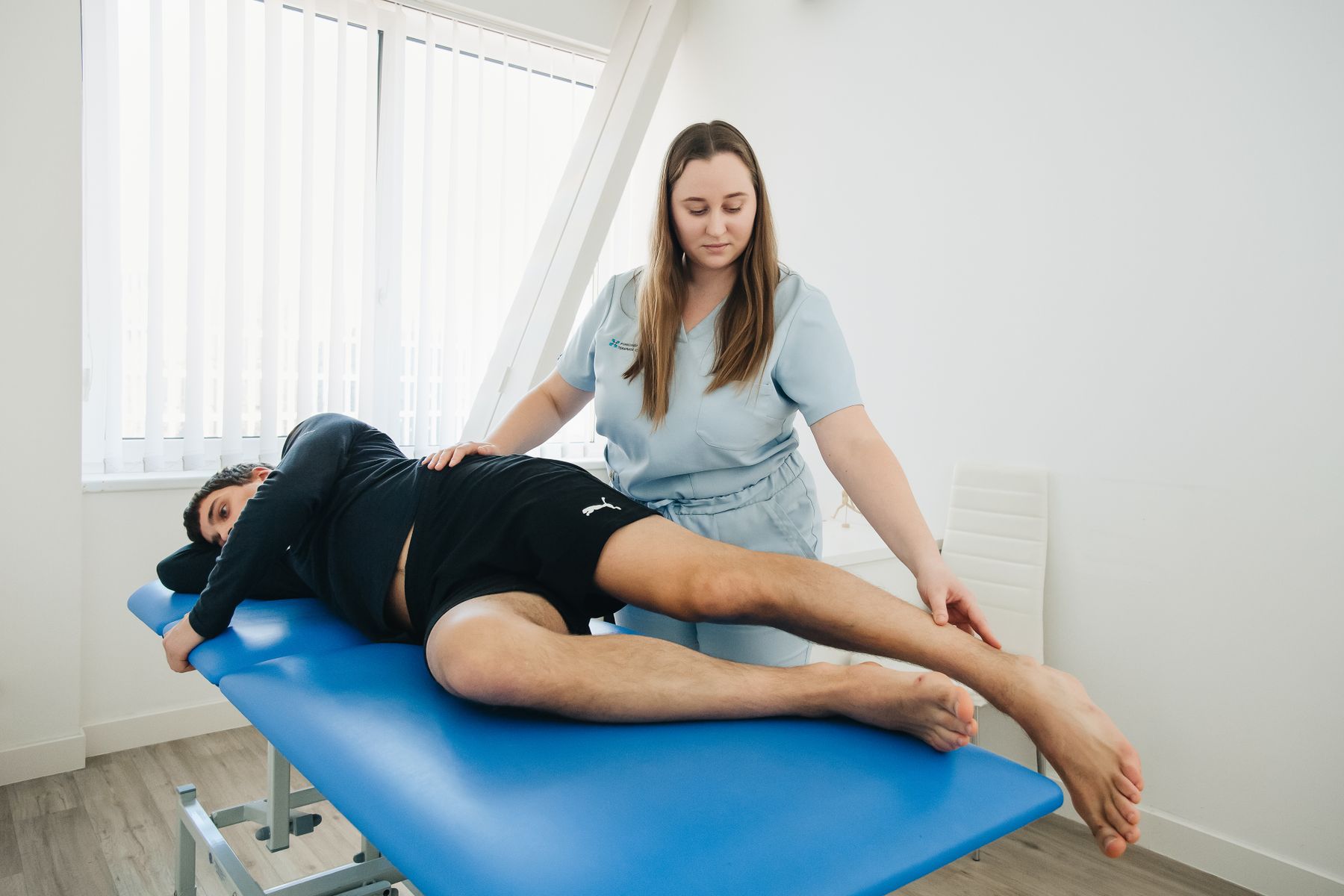
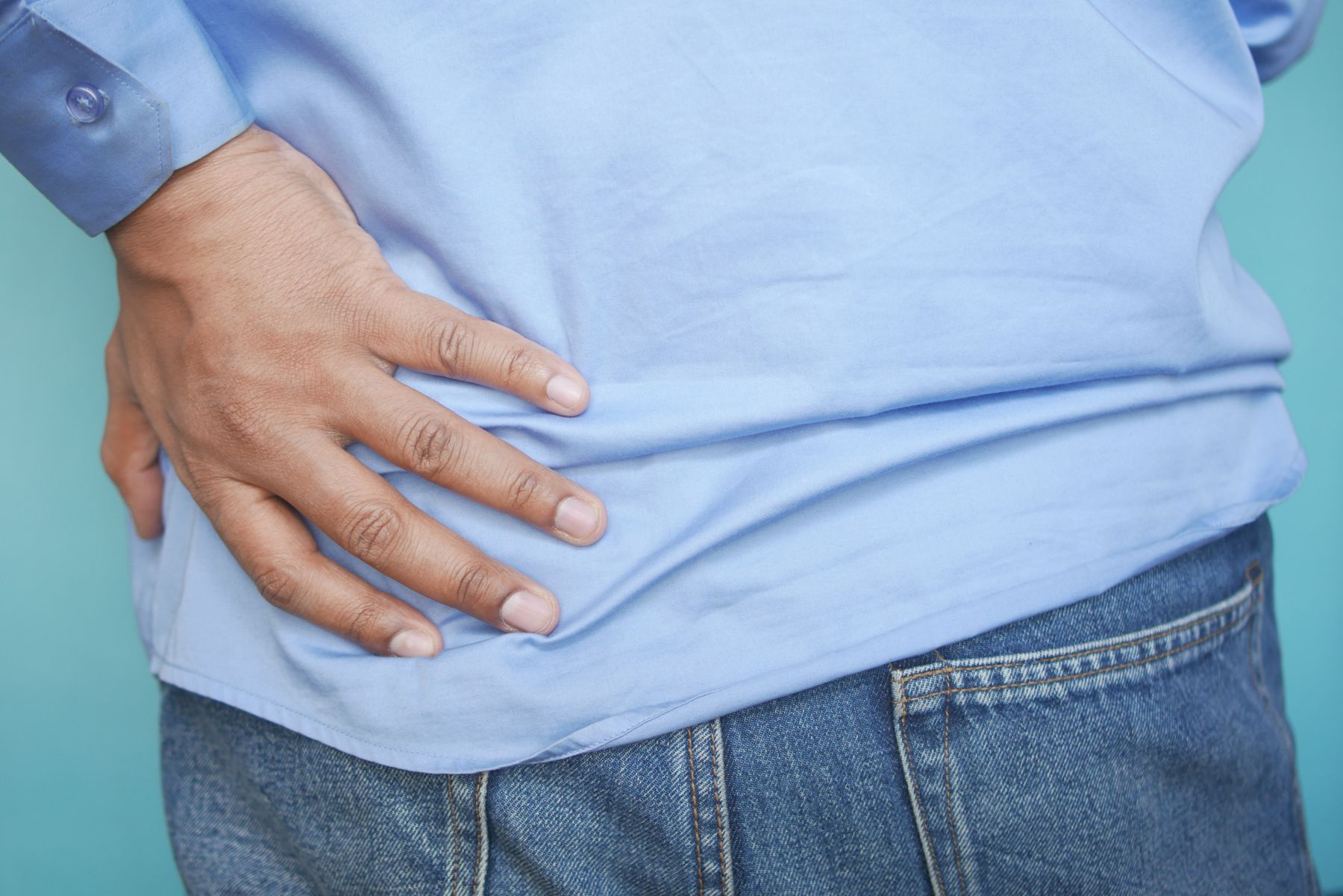
One-sided, just below the belt line, and you can cover it with a fingertip. Nothing is out of place — but the joint has stopped tolerating being loaded on one leg, and that is a trainable problem.
The sacroiliac joint is the weight-bearing junction between the base of the spine and the pelvis, and it is thought to be the source of roughly 15% to 30% of mechanical low back pain.[1] It is also the joint most often misdescribed: it is the largest joint in the body by surface area and moves only about 2 to 4 mm in any direction, so it does not slip out of place and cannot be put back in.[1] The tests clinicians use to identify it are better at ruling it out than ruling it in — a positive cluster leaves about 35% certainty, a negative one about 92%.[2] RISE Physical Therapy treats SI joint pain one-on-one in 45-minute sessions in Boise and Nampa, Idaho, and builds the plan around single-leg tolerance rather than realignment.
What is the SI joint, and what does SI joint pain feel like?
SI joint pain is pain coming from the sacroiliac joint — the pair of joints where the sacrum, the triangular bone at the base of the spine, meets the ilium on each side of the pelvis. Their job is structural rather than mobile: everything your upper body weighs has to cross them to reach your legs. The joint surface covers around 17.5 cm², making it the largest joint in the body, and the movement available to it is roughly 2 to 4 mm in any direction.[1]
The symptom pattern is unusually specific for a back complaint. People with SI joint pain typically point to one spot with one finger — the dimple at the back of the pelvis, an inch or two below the belt line, on one side. From there it spreads downward into the buttock and the back of the thigh. Of the documented referral patterns, the posterior or lateral thigh is involved in about 50% of cases, pain travels below the knee in roughly 28%, and reaches the foot in around 14%.[1] That last group is the reason SI joint pain is so often mistaken for a disc problem.
What provokes it is asymmetry — loading one leg at a time. The complaints we hear most are stairs, stepping out of a car, rolling over in bed, standing on one leg to put trousers on, and sitting on a hard surface or with a wallet under one buttock. Unlike most spinal pain, it usually has a start date: pain from this joint usually follows an inciting event rather than creeping in.[1] If you can name the fall, the pregnancy or the collision, that history is doing real diagnostic work.
What causes SI joint pain?
SI joint pain has a short and fairly consistent list of causes: trauma, pregnancy, repetitive one-sided loading, and previous lumbar fusion surgery.[1] It tends to arrive in two age groups for different reasons — younger adults after an injury or a pregnancy, and older adults as the joint degenerates.[1]
Trauma is the cleanest version: a fall directly onto one buttock, a missed step off a kerb, or a motor vehicle collision where one leg was braced against the floor. Repetitive loading is the version athletes and tradespeople get, where months of running on a cambered road, kicking off the same leg, or carrying a load on one hip gradually outstrip what the joint tolerates. Lumbar fusion matters because it removes motion from the segments above and the pelvis absorbs the difference — which is why new SI pain after spine surgery is a recognised pattern rather than a coincidence.
And a category that is not mechanical at all: inflammatory sacroiliitis. In axial spondyloarthritis the SI joints are inflamed by a systemic disease process, and the giveaway is that the symptoms behave backwards — worse with rest, better with movement, stiff for more than half an hour in the morning, often waking the person in the second half of the night, and usually starting before age 45. That pattern is a rheumatology referral, not a course of exercise, and separating it from mechanical SI pain is part of what a first evaluation is for.
How is SI joint pain diagnosed — and can it be "out of alignment"?
SI joint pain is diagnosed with a cluster of pain provocation tests, and the honest answer is that those tests are much better at ruling the joint out than ruling it in. The standard approach is to stress the joint in five or six different directions and treat three or more positive tests as meaningful. A 2021 systematic review with meta-analysis pooled the studies and put numbers on what that buys you: a positive likelihood ratio of 2.13 and a negative likelihood ratio of 0.33, which at a 20% background prevalence translates to about 35% certainty after a positive cluster and about 92% certainty after a negative one — with the certainty of the underlying evidence graded very low.[2]
Read that carefully, because it changes what an honest clinician can promise you. If the tests are negative, we can be reasonably confident your problem is somewhere else and go looking. If they are positive, the SI joint has become the leading suspect and nothing more. Image-guided injection remains the reference standard for actually confirming the joint as the pain source,[1] and no scan can make the diagnosis on its own — plenty of degenerate-looking SI joints belong to people with no pain at all. So the first block of treatment is best understood as a test of the hypothesis, which is why it should come with an agreed date for deciding whether it worked.
Pregnancy-related pelvic girdle pain overlaps heavily with SI joint pain. Roughly 45% of pregnant women report pelvic girdle or low back pain, and about a quarter still have complaints after delivery.[3]
Which brings us to the claim almost everyone with this diagnosis has heard: that their SI joint is "out" and needs putting back. The anatomy does not allow it. A joint with 17.5 cm² of interlocking surface, bound by some of the strongest ligaments in the body, with 2 to 4 mm of total available motion, is not subluxing and relocating between appointments.[1] Manipulation and mobilisation of the region genuinely do reduce pain, sometimes within a single session — that effect is real and it is worth using. What it is not is evidence that something was displaced. The distinction matters because the realignment story quietly teaches people that their pelvis is fragile and needs regular correcting, and that belief costs more over a decade than the technique ever gains.
Is SI joint pain common in pregnancy and after birth?
Yes — pregnancy is one of the most common settings for SI joint pain, and the numbers are larger than most people expect. Around 45% of pregnant women report pelvic girdle pain, low back pain or both; roughly 25% describe the pain as serious, and about 8% report severe disability from it.[3] After delivery, approximately 25% still have complaints and around 7% have problems serious enough to need intervention.[3]
The reassuring part of that data is the trajectory: about 93% of postpartum pelvic girdle pain resolves on its own within three months.[3] The part worth acting on is the remainder — the 7% whose pain does not settle in that window are, in the authors' own framing, at considerable risk of prolonged serious pain.[3] That is the single most useful thing to know if you are three months postpartum and still hurting on stairs: waiting it out has already been tried, and the group you are now in is the one where early treatment has the most to offer. If pelvic floor symptoms sit alongside the joint pain, our pelvic floor therapy and postpartum recovery pages cover that side of it.
What does the research say about physical therapy for SI joint pain?
The research on physical therapy for SI joint pain is consistently positive and consistently small. Active treatment beats doing nothing in every trial that has tested it; almost every one of those trials is limited enough that the honest conclusion is directional rather than precise.
SYSTEMATIC REVIEW · 2017
Nine studies of manipulation, exercise and kinesio taping for SI joint dysfunction. All three reduced pain and disability, manipulation fastest — but the included studies were rated low to average quality, with small samples and limited blinding.
120 adults aged 30–60 randomised to motor control exercise, balance training, both, or usual care for 12 weeks. The combined group reached a median pain score of 2.8/10 versus 6.5 for usual care, and disability of 15% versus 37%.
The 2017 review is the closest thing the field has to a summary, and its verdict was that manipulation, exercise and taping all help, with manipulation producing the quickest change in pain.[4] Its authors were candid about what sat underneath that: nine studies ranging from single cases to 65 participants, most without blinding, several without proper randomisation, and inconsistent follow-up.[4] It is a reasonable basis for choosing a direction of treatment and a poor basis for predicting your result.
The 2023 trial is the better-built one, and it is the reason our programmes lean the way they do. Adults aged 30 to 60 were randomised across four arms for 12 weeks of twice-weekly supervised sessions. The group that got motor control exercise and balance training finished with a median pain score of 2.8 out of 10 against 6.5 for usual care, an Oswestry Disability Index of 15% against 37%, and quality-of-life scores that held at the 24-week follow-up — outperforming either component on its own.[5] The authors name their own limits plainly: a narrow age band of 30 to 60, and no follow-up beyond 24 weeks, so nothing is known about whether the gains hold at two years.[5]
What we take from all of it is modest and useful. Combining hands-on treatment with progressive loading looks better than either alone; the loading that matters is single-leg and balance-based rather than generic core work; and anyone quoting you a percentage success rate for an SI joint protocol is quoting a number that does not exist in this literature.
When do injections or SI joint fusion come in?
Injections and fusion belong after a genuine course of conservative care has been tried and measured, not instead of one. The usual escalation runs from exercise, manual therapy, anti-inflammatories and a pelvic belt, through image-guided steroid injection and radiofrequency denervation of the nerves supplying the joint, to surgical fusion.[1] An image-guided injection does double duty — it is both a treatment and the reference standard for confirming the joint is genuinely the source.[1]
Fusion has the strongest surgical evidence and it needs reading with its caveats attached. A randomised trial comparing minimally invasive SI joint fusion against conservative management reported substantially better one-year results for surgery — low back pain scores of 14.0 versus 41.6 and disability scores of 8.7 versus 25.0 — with benefits persisting at two years.[6] The caveats are not small: outcome assessment was not blinded and the primary measures were patient-reported, in a trial where everyone knew which group they were in; participants could cross over from conservative care to surgery at six months, and those who did improved at similar rates.[6] Older surgical experience was considerably less happy — one study cited in the standard clinical reference on this condition reported that 82% of patients were unsatisfied after surgery.[1]
None of that makes surgery wrong for the right person. It makes the sequence matter. Because the diagnosis itself is only about 35% certain on clinical testing,[2] operating on an unconfirmed hypothesis is a real risk, and conservative treatment that fails is itself informative — it is part of how the case for anything more invasive gets built honestly.
What SI joint symptoms need urgent or medical care?
A handful of patterns turn pelvic pain from a physical therapy problem into a medical one. Go to an emergency department the same day for:
New loss of bladder or bowel control, or new difficulty passing urine
Numbness in the groin, genitals or the area you sit on
Rapidly progressing weakness in both legs
And see a physician before starting therapy for:
Inflammatory features — morning stiffness over 30 minutes, night pain in the second half of the night, improvement with movement rather than rest, onset before 45: this pattern suggests axial spondyloarthritis and needs a rheumatology opinion
Fever, chills or a recent infection with new pelvic pain — septic sacroiliitis is uncommon but serious
Unexplained weight loss, or a history of cancer
Significant trauma — a heavy fall or collision, especially with difficulty bearing weight, which needs imaging first
Screening for every one of these is a fixed part of the pelvic and spine evaluations we run in Boise and Nampa. It is why an appointment you booked about stairs includes questions about your sleep, your morning stiffness and your general health.
How we treat SI joint pain at RISE
SI joint care at RISE is built around one question: how much load can you take through one leg before it hurts? That is the demand the joint is failing, it is measurable, and it responds to training. We are equally explicit about what we are not doing — we are not realigning anything, and we are not signing you up for maintenance adjustments. Getting that right takes a full 45 minutes one-on-one with the same Doctor of Physical Therapy every session, because the diagnosis is provisional and the plan has to keep being checked against how you actually respond.
Rule the joint in — or out: a full provocation battery plus lumbar and hip screening, read for what it is worth: strong evidence against the SI joint when negative, a working hypothesis when positive.
Screen for what isn't mechanical: inflammatory, infective and traumatic patterns get named at the first visit and referred on, not treated with exercise.
Measure single-leg tolerance: stance time, step-up and stair tolerance, and what you can no longer do without bracing — the numbers we will judge the plan by.
Use hands-on work for the window it opens: manipulation and mobilisation change pain quickly in the trials that tested them, which is what makes the loading work possible sooner.
Train the pattern that actually failed: hip abductor and gluteal strengthening, motor control and balance training together — the combination that outperformed either alone in the 2023 trial.
Ration asymmetry, then reintroduce it: belt, sleep position and standing habits managed while it is irritable, and deliberately loaded again before discharge so ordinary life doesn't reproduce it.
Provocation cluster, lumbar and hip screening, red-flag and inflammatory questions — so you leave knowing what we think it is, how confident that is, and what would change our mind.
02 — SETTLE
Take the heat out of it
Manual therapy and manipulation, a pelvic belt if it helps immediately, and short-term changes to the asymmetric loads that keep re-provoking the joint through the day.
03 — LOAD
Make one leg trustworthy again
Progressive hip and gluteal strengthening with motor control and balance work, taken far enough that stairs, cars and bad nights stop being events worth planning around.
What to expect at your first visit
The history that narrows it fast. Where you point with one finger, whether there was a start date, what one-legged tasks cost you, and how your mornings and nights behave — those answers separate mechanical SI pain from inflammatory disease and from a nerve root before anyone touches you.
The provocation battery, plus its neighbours. Five or six tests that stress the joint from different directions, run alongside lumbar spine and hip testing, because the hip and the disc are the two things most often mistaken for this.
Measured single-leg loading. Stance time, step-ups, stairs — recorded as numbers so that progress is something we can show you rather than ask you about.
A straight answer about certainty. You will be told how confident the finding is, what the alternatives are, and what a positive cluster does and does not mean. If it looks inflammatory or systemic, you get a letter to your physician instead of a treatment plan.
A plan with a decision point. Home exercises you can actually fit in, belt and loading guidance for the irritable phase, and an agreed date by which the numbers should have moved — with referral for an image-guided injection or a specialist opinion if they haven't.
Frequently asked questions
How is SI joint pain different from sciatica?+
The quickest separator is where the pain starts and how far down it travels. SI joint pain starts at a single point just below the belt line, to one side, and most often spreads no further than the buttock and the back of the thigh — referral below the knee happens in roughly 28% of documented cases and into the foot in about 14%.[1] Sciatica is a nerve-root problem: it typically runs the full length of the leg in a band, comes with pins and needles, numbness or weakness in a pattern that matches one nerve root, and is often reproduced by a straight leg raise rather than by loading one leg. The two are not mutually exclusive, and a person can have a narrowed nerve root and an irritable SI joint at once, which is exactly why the first visit tests both rather than assuming either.
Can an SI joint be out of place, and can it be put back in?+
No, and this is the single most common thing people have been told that is not supported by the anatomy. The sacroiliac joint is the largest joint in the body at roughly 17.5 cm² of surface area, it is bound by some of the strongest ligaments in the human skeleton, and its total available movement is about 2 to 4 mm in any direction.[1] Nothing in that structure slips out and gets put back. What manipulation and mobilisation genuinely do is change how painful and how guarded the area is — sometimes quickly and dramatically — and that is a worthwhile effect on its own.[4] But the pop is not a relocation, the relief does not prove a joint was displaced, and the clinicians who can reliably feel a 2 mm positional difference through skin and muscle have not shown up in the reliability studies. We treat the joint's tolerance to load, not its address.
How is SI joint pain diagnosed?+
Mostly by a battery of pain provocation tests, and it is worth knowing up front how blunt that instrument is. Standard practice is to run five or six tests that stress the joint in different directions and to treat three or more positive as meaningful. A 2021 systematic review with meta-analysis in the Journal of Orthopaedic & Sports Physical Therapy pooled the evidence and found a positive likelihood ratio of 2.13 and a negative likelihood ratio of 0.33 — meaning that at a 20% background prevalence, a positive cluster leaves you only about 35% certain the SI joint is the culprit, while a negative cluster lets you conclude with about 92% certainty that it is not. The certainty of that evidence was rated very low.[2] So the cluster is a good tool for ruling the joint out and a weak one for ruling it in, image-guided injection remains the reference standard for confirmation, and plain imaging cannot make the diagnosis at all.[1] In practice that means an initial treatment plan is a hypothesis being tested, and it should come with a date by which it has to be working.
Does physical therapy work for SI joint pain?+
The evidence is positive but thin, and we would rather say so than oversell it. A 2017 systematic review of nine studies found manipulation, exercise and kinesio taping all reduced pain and disability in sacroiliac joint dysfunction, with manipulation producing the fastest change — while rating the included studies low to average quality, with small samples, little blinding and limited randomisation.[4] A better-designed 2023 randomised controlled trial of 120 adults aged 30 to 60 compared motor control exercise, balance training, both together, and usual care over 12 weeks; the combined group finished with a median pain score of 2.8 out of 10 against 6.5 for usual care and an Oswestry Disability Index of 15% against 37%, and held those gains at 24 weeks.[5] Its authors note the narrow age band and the absence of follow-up beyond 24 weeks. Taken together: active treatment clearly beats doing nothing, combining hands-on work with progressive loading looks better than either alone, and nobody has yet earned the right to quote you a success rate.
What exercises help SI joint pain, and what should I avoid?+
The exercises that help SI joint pain are generally the ones that build tolerance to loading one leg at a time, because that is the demand the joint actually fails at. Hip abductor and gluteal strengthening, controlled single-leg work such as step-ups and split stance, trunk and hip motor control drills, and balance training all sit at the centre of the programmes that have been tested — the 2023 trial that combined motor control exercise with balance training produced the largest effect of its four arms.[5] What tends to provoke it is asymmetry held for a long time: standing hipshot on one leg, sitting cross-legged or on a wallet, sleeping without a pillow between the knees, deep or end-range stretching of an already irritable joint, and pushing through a long walk on a bad day. None of these are permanently forbidden. They are the things to ration while the joint is sore and to reintroduce deliberately once it is not, because the goal is a pelvis that tolerates ordinary asymmetric life rather than one that has to be protected from it.
Do SI joint belts work?+
A pelvic belt is a reasonable short-term aid for SI joint pain and a poor long-term plan. Belts are a standard part of conservative care alongside exercise, anti-inflammatories and manual therapy,[1] and many people find that a snug belt worn low across the pelvis — below the crest of the hip bones, not around the waist — makes walking, stairs and standing noticeably easier within minutes. That immediate response is genuinely useful information as well as relief. What the evidence does not support is wearing one indefinitely: the trial evidence for belts is thinner than for exercise, and the muscles that need to take over the job do not get stronger while something else is doing it. We use a belt the way you would use a crutch — to keep you moving during the weeks when loading hurts, with a plan to come off it as single-leg strength returns.
When does SI joint pain need a doctor rather than a physical therapist?+
Three patterns should go to a physician first. The first is inflammatory: morning stiffness in the back and pelvis that lasts more than 30 minutes, pain that wakes you in the second half of the night, symptoms that improve with movement rather than rest, and onset before age 45 — that combination points at axial spondyloarthritis rather than a mechanical joint problem and needs a rheumatology opinion, not a treatment table. The second is infection or systemic illness: fever, chills, a recent infection, unexplained weight loss, or a history of cancer alongside new pelvic pain. The third is the emergency list common to all spine and pelvis problems — new loss of bladder or bowel control, numbness in the groin or the area you sit on, or rapidly progressing weakness in both legs, which is a same-day emergency department visit. Significant trauma with an inability to bear weight belongs in imaging before therapy as well. Screening for all of this is part of a first evaluation at RISE, which is why we ask questions that seem unrelated to your hip.
Do I need a referral for physical therapy for SI joint pain in Idaho?+
No. Idaho is a direct-access state, so you can book an evaluation at RISE in Boise or Nampa without a physician referral first. Two caveats matter for this condition specifically. Some insurance plans — Medicare, Medicaid and Tricare among them — require a referral for coverage regardless of what state law allows, so we verify your plan before the first appointment rather than after it. And direct access cuts both ways: pelvic pain that turns out to be inflammatory, infectious or post-traumatic is not ours to treat, and part of what you are paying for at an evaluation is someone qualified to recognise that and send you to the right place. If your history or your screening points away from a mechanical SI joint problem, you leave with a letter to your physician instead of a home programme.
Does insurance cover physical therapy for SI joint pain?+
Physical therapy for SI joint pain is covered by most major medical plans and by Medicare, and it is typically the care an insurer expects to see documented before it will authorise an image-guided injection, a radiofrequency procedure or a surgical consult. What actually determines your cost is your visit allowance, your deductible and coinsurance, whether the plan requires a referral or prior authorisation, and — with Medicare in particular — whether the notes show measurable progress rather than maintenance. That is a practical reason as well as a clinical one to track specific numbers like single-leg stance time and stair tolerance rather than only asking how the week felt. RISE is in-network with most major insurance plans in Idaho; send us your details and we will verify your benefits before your first appointment.
Carson is a co-founder of RISE Physical Therapy and treats orthopedic, sports, and spine conditions with a hands-on, movement-first approach. He earned his Doctorate of Physical Therapy from Pacific University in Oregon. Meet the full team →
Saueressig T, Owen PJ, Diemer F, Zebisch J, Belavy DL. Diagnostic Accuracy of Clusters of Pain Provocation Tests for Detecting Sacroiliac Joint Pain: Systematic Review With Meta-analysis. Journal of Orthopaedic & Sports Physical Therapy, 2021;51(9):422–431. jospt.org/doi/10.2519/jospt.2021.10469
Wu WH, Meijer OG, Uegaki K, et al. Pregnancy-related pelvic girdle pain (PPP), I: Terminology, clinical presentation, and prevalence. European Spine Journal, 2004;13(7):575–589. pmc.ncbi.nlm.nih.gov/articles/PMC3476662
Al-Subahi M, Alayat M, Alshehri MA, et al. The effectiveness of physiotherapy interventions for sacroiliac joint dysfunction: a systematic review. Journal of Physical Therapy Science, 2017;29(9):1689–1694. pmc.ncbi.nlm.nih.gov/articles/PMC5599847
Alqhtani RS, Ahmed H, Alshahrani A, et al. Synergistic Benefits of Motor Control Exercises and Balance Training in Sacroiliac Joint Dysfunction: A Randomized Controlled Trial. Life (Basel), 2023;13(12):2258. pmc.ncbi.nlm.nih.gov/articles/PMC10745022
Dengler J, Kools D, Pflugmacher R, et al. Randomized Trial of Sacroiliac Joint Arthrodesis Compared with Conservative Management for Chronic Low Back Pain Attributed to the Sacroiliac Joint. Journal of Bone and Joint Surgery (American), 2019;101(5):400–411. pubmed.ncbi.nlm.nih.gov/31663051
 Medically reviewed by Dr. Carson Bailey, PT, DPT · September 2026