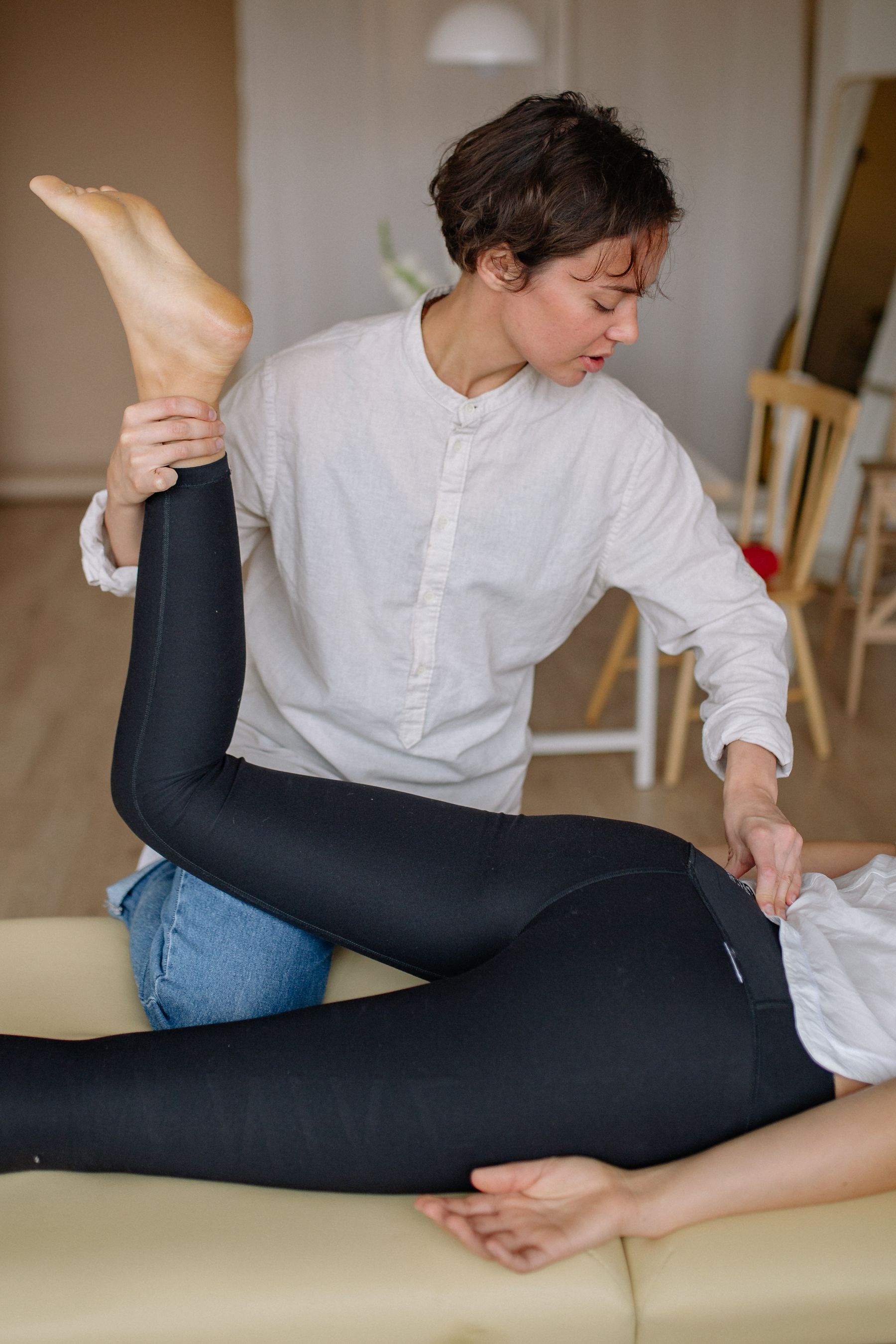
A pinch in the groin at the bottom of a squat, an ache that finds you every time you lie on that side — hip pain has distinct patterns, and each one has a plan.
Hip pain in active adults most often comes from femoroacetabular impingement (FAI), labral irritation, gluteal tendinopathy, or early arthritis — each with its own signature. Physiotherapist-led exercise programs are an evidence-supported first-line treatment for hip impingement and tendinopathy, often making surgery unnecessary. RISE Physical Therapy treats hip pain one-on-one in 45-minute sessions in Boise and Nampa, Idaho, with no referral required.
What causes hip pain?
"Hip pain" covers several different problems that get treated very differently. Femoroacetabular impingement syndrome (FAI) is a motion problem — extra bone contact between the ball and socket that pinches the joint's cartilage rim (the labrum) in deep flexion. Gluteal tendinopathy is a load problem of the tendons on the outside of the hip. Early osteoarthritis is a capacity problem of the joint surfaces. And a meaningful share of "hip" pain is actually referred from the lumbar spine.
Location is the first clue: impingement and joint problems tend to live in the groin — many patients make a "C" with their hand around the front of the hip when describing it — while gluteal tendinopathy aches over the bony point on the side, and back-referred pain favors the buttock. The exam then confirms with specific joint, tendon, and spine tests, because the label determines the plan.
Symptoms: when should you seek help?
Hips rarely improve by ignoring them — the usual course is a slowly shrinking list of comfortable positions. Book an evaluation if you notice:
Pinching in the groin with deep squats, long sitting, or getting out of the car
Aching on the outside of the hip, worst lying on that side at night
Clicking, catching, or a sense the hip needs to "pop"
Stiffness rotating the leg — putting on socks and shoes has gotten complicated
Pain that follows runs, hikes, or leg days and lingers longer each time
Hip pain after a fall in an older adult, pain with inability to bear weight, fever, or night pain that doesn't change with position warrants medical evaluation first.
Groin pinching, lateral aching, and buttock pain each point to a different hip diagnosis — and a different plan.
Does physical therapy work for hip impingement?
The evidence says it's a legitimate first choice. The UK FASHIoN randomized trial formalized "Personalised Hip Therapy" — a physiotherapist-led program of assessment, education, and individualized, progressive hip strengthening delivered over 12–26 weeks — as the non-operative standard for femoroacetabular impingement syndrome.[1] A systematic review and meta-analysis of five randomized trials supports physiotherapy as an initial treatment for FAI,[2] and a multilevel meta-analysis comparing conservative care with hip arthroscopy found meaningful improvement in both pathways.[3]
The honest read: arthroscopy produced somewhat larger average improvements in some trials, and surgery remains right for hips that fail quality rehab — but a structured strengthening program resolves symptoms for a large share of patients at far lower cost and risk, and rehab first never burns the surgical option. For gluteal tendinopathy and early hip OA, progressive loading is even more clearly the front-line treatment.
How we treat hip pain at RISE
Hip care at RISE starts by naming the actual problem — impingement, tendon, joint, or spine — then building the specific progressive program that presentation needs. Every session is 45 minutes one-on-one with the same Doctor of Physical Therapy.
Differential exam: joint, tendon, and lumbar screening separates the four big causes of hip pain before any plan gets written.
Individualized strengthening: deep hip rotators, glutes, and trunk — progressed weekly, the core of every evidence-based hip protocol.
Movement retraining: squat depth, stride, and daily positions adjusted so the hip trains without re-pinching.
Hands-on adjuncts: manual therapy and dry needling for the guarded hip flexors, glutes, and lateral hip that make loading tolerable.
Joint, tendon, and spine testing identifies which hip problem you actually have — the step that can't be skipped.
02 — TREAT
Calm the irritation
Position changes, manual therapy, and early-dose loading settle symptoms while keeping you active.
03 — REBUILD
Strengthen the system
Progressive hip and trunk strengthening returns squats, hikes, and sleep — measured against baseline, not memory.
What to expect at your first visit
Your story first. Where exactly it hurts, which positions provoke it, and how it behaves across a week of work, training, and sleep.
A differential exam. Hip joint tests, tendon load tests, strength measures, and a lumbar screen — the hip's great mimic.
Plain-language findings. Which structure is driving symptoms, what that means for your activities, and the realistic timeline.
Treatment on day one. Hands-on work plus your first correctly-dosed exercises and position modifications.
A progressive plan. Weekly loading progressions with clear milestones — and honest triage if your presentation warrants imaging or a surgical opinion.
Frequently asked questions
Can hip impingement be treated without surgery?+
Often, yes. Physiotherapist-led care for femoroacetabular impingement syndrome — built on individualized, progressive hip strengthening, movement retraining, and education — was formalized as Personalised Hip Therapy in the UK FASHIoN trial,[1] and meta-analyses of randomized trials support physiotherapy as a credible initial treatment.[2] Surgery remains an option for hips that don't respond, and starting with rehab doesn't close that door.
Why does the outside of my hip hurt when I lie on my side?+
That pattern usually points to gluteal tendinopathy — irritation of the gluteus medius and minimus tendons at the bony point of the hip — rather than the joint itself. It's most common in women over 40 and responds to progressive hip strengthening plus temporarily avoiding compressive positions like crossing your legs or side-lying directly on the sore hip.
Do I need a referral for hip pain treatment in Idaho?+
No. Idaho is a direct-access state, so you can book a hip evaluation at RISE without a physician referral. Some insurance plans — commonly Medicare, Medicaid, and Tricare — require a referral for coverage, and we'll verify your plan's requirements before your first visit.
Is my hip pain actually coming from my back?+
It's a real possibility — the lumbar spine refers pain to the buttock and hip region frequently enough that every RISE hip evaluation screens the back too. As a rough guide, true hip joint pain tends to live in the groin and front of the thigh, while back-referred pain favors the buttock. The exam sorts it out with specific joint and nerve tests rather than guesswork.
Should I stretch a pinching hip?+
Careful — aggressive stretching into the pinch often makes impingement-type hip pain worse, because the pinching position itself is the irritant. Most impinging hips need strength and control through the range they own, plus temporary trimming of the deepest positions, rather than forcing more depth. Some hips do need mobility work; the exam tells us which kind yours is.
How long does hip pain take to improve with physical therapy?+
Structured hip programs typically run 8–12 weeks, with most people noticing meaningful change by weeks 4–6. Personalised Hip Therapy in the FASHIoN trial was delivered over 12–26 weeks for impingement.[1] A typical RISE plan runs 8–12 visits with a progressive home and gym program between sessions — tendon and joint tissue adapt on a weeks-to-months timescale.
Does insurance cover physical therapy for hip pain?+
Most major medical plans cover physical therapy for hip pain, impingement, and gluteal tendinopathy. RISE is in-network with most major insurance plans in Idaho — check our insurance list or contact us and we'll verify your coverage before your first appointment.
Carson is a co-founder of RISE Physical Therapy and treats orthopedic, sports, and hip conditions with a hands-on, movement-first approach. He earned his Doctorate of Physical Therapy from Pacific University in Oregon. Meet the full team →
SOURCES
Personalised Hip Therapy: Development of a Non-Operative Protocol to Treat Femoroacetabular Impingement Syndrome in the FASHIoN Randomised Controlled Trial. BMJ Open Sport & Exercise Medicine, 2016. ncbi.nlm.nih.gov/pmc/articles/PMC5036255
Physiotherapy as an Initial Treatment Option for Femoroacetabular Impingement: A Systematic Review of the Literature and Meta-Analysis of 5 Randomized Controlled Trials. American Journal of Sports Medicine, 2020. pubmed.ncbi.nlm.nih.gov/31774704
Conservative Treatment versus Hip Arthroscopy in Patients with Femoroacetabular Impingement: A Multilevel Meta-Analysis of Randomized Controlled Trials. 2025. ncbi.nlm.nih.gov/pmc/articles/PMC12014245
 Medically reviewed by Dr. Carson Bailey, PT, DPT · August 2026