An arthritic hip does not have to decide how far you walk. It does need a plan with numbers in it — and an honest account of what exercise can and cannot do.
Hip arthritis — hip osteoarthritis — is a whole-joint condition of the ball-and-socket hip that produces deep groin pain, lost rotation, and a shrinking walking radius, and it is common: about 9.2% of US adults aged 45 and over have symptomatic hip osteoarthritis, with an estimated lifetime risk of 28.6% for women and 18.5% for men.[1] No treatment regrows hip cartilage, but exercise-based care measurably improves pain and function and has been shown in one randomised trial to postpone hip replacement.[5] RISE Physical Therapy treats hip osteoarthritis one-on-one in 45-minute sessions in Boise and Nampa, Idaho, and Idaho's direct-access law lets you start without a physician referral.
What is hip arthritis?
Hip arthritis is osteoarthritis of the hip joint — a slow change in the whole joint, not just a worn strip of cartilage. The hip is a deep ball-and-socket: the head of the femur sits inside the acetabulum of the pelvis, lined by a rim of cartilage called the labrum and wrapped in a thick capsule. In osteoarthritis the articular cartilage thins, the bone underneath remodels and stiffens, the capsule tightens, and the muscles that control the joint quietly lose strength. Every one of those four changes contributes to symptoms, and three of them respond to training.
It is more common than most people assume and less inevitable than the phrase "wear and tear" implies. Among US adults aged 45 and older, roughly 27% show radiographic signs of hip osteoarthritis while about 9.2% have symptomatic disease — meaning most hips with visible changes on film are not the hips that hurt.[1] Estimated lifetime risk is 28.6% for women and 18.5% for men.[1] Men have a higher prevalence before about age 50 and women after it.[1]
Clinicians divide it into primary hip osteoarthritis, where no single cause is identifiable, and secondary, where the joint had a head start: hip dysplasia, femoroacetabular impingement, a childhood hip condition, avascular necrosis, or an old fracture through the joint. The distinction matters because it shapes what we look for. A 58-year-old with a shallow socket and a lifetime of hiking the Boise Foothills has a different rehab problem than a 72-year-old whose hip stiffened over a decade of desk work.
Range of motion is the measurement that matters most in an arthritic hip — losing internal rotation is usually the earliest objective sign, and it is the one we track visit to visit.
What does hip arthritis feel like?
Hip arthritis usually feels like a deep ache in the groin that builds with walking distance and eases with rest, paired with stiffness in the morning that loosens within about half an hour.[1] The location surprises people: it is a groin problem far more often than a "side of the hip" problem, and it commonly refers into the buttock, the front of the thigh, and sometimes the knee.[1] Patterns we hear most weeks in the clinic:
Deep groin or front-of-hip pain that comes on partway into a walk and settles once you sit down
Morning stiffness that eases inside 30 minutes — unlike inflammatory arthritis, where it drags on much longer[1]
Trouble putting on socks and shoes, or clipping toenails, on the affected side
Difficulty getting in and out of the car, which is a rotation task more than a strength task
A shortening stride or visible limp late in a walk, and a shrinking "walking radius" — the loop around the neighbourhood that used to be routine
Thigh or knee pain with a knee that examines and images normally
In more advanced disease, pain at rest or at night, and pain that no longer respects the activity that caused it
Two things are worth flagging. Pain directly over the bony point on the outside of the hip is usually gluteal tendon or bursal irritation rather than joint arthritis — a different problem covered on our hip pain and impingement page. And stiffness that lasts well over an hour, in several joints, with swelling or systemic symptoms, is not the osteoarthritis pattern and needs a physician.
What causes hip arthritis, and who gets it?
Hip osteoarthritis comes from an accumulation of load, joint shape, and biology rather than a single cause. The risk factors with the most consistent support are advancing age — particularly past 60 — female sex after menopause, obesity, a genetic and family history component, and occupations involving heavy physical labour and repeated loaded bending.[1] Joint shape sits alongside them: dysplasia leaves the femoral head under-covered, and impingement-shaped hips pinch the labral rim at end range.
Body weight is the risk factor most worth acting on, because it is one of the few that moves. The 2019 American College of Rheumatology and Arthritis Foundation guideline strongly recommends weight loss for people with hip or knee osteoarthritis who are overweight or obese, noting that losing at least 5% of body weight is associated with meaningful clinical change and that benefits keep increasing at 5–10%, 10–20%, and beyond.[6] The same guideline strongly recommends exercise for hip osteoarthritis, without prescribing a single "best" type.[6]
What we would gently push back on is the idea that using the hip caused this. Muscle weakness and reduced activity are as often consequences of an arthritic hip as causes of one, and the spiral runs downhill fast: the hip hurts, you walk less, the glutes weaken, the joint tolerates less, you walk less again. Interrupting that loop is most of what rehab does.
Does exercise actually work for hip arthritis?
Exercise helps hip arthritis, but the effect is smaller than the fitness industry implies and the honest version is worth hearing before you commit to a program. The most recent Cochrane review, updated in July 2026, pooled 18 randomised trials and 1,368 people with hip osteoarthritis and concluded that compared with no treatment, usual care, or limited education, land-based exercise probably produces small improvements in pain and physical function — improvements the authors judged unlikely to be clinically meaningful for many patients. Compared with an attention-control or placebo intervention, exercise may have little to no effect on pain and only slightly improve function.[2]
A 2023 systematic review and cumulative meta-analysis puts numbers on the same picture. Immediately after treatment, exercise therapy improved pain by a standardised mean difference of −0.38 (95% CI −0.55 to −0.22) and function by −0.31 (95% CI −0.49 to −0.11); at six to nine months the effects were still present but smaller, at −0.23 for pain and −0.29 for function. The authors' own summary is that exercise therapy for hip osteoarthritis is effective, but the effect is small and not clearly clinically worthwhile.[3]
COCHRANE REVIEW · 2026
Across 18 trials and 1,368 people with hip osteoarthritis, exercise produced small improvements in pain and physical function versus no treatment or usual care — gains the reviewers judged unlikely to be clinically meaningful.
In 102 adults with painful hip osteoarthritis, 10 sessions of multimodal physical therapy over 12 weeks produced no greater improvement in pain or function than a sham program of inactive ultrasound and inert gel.
The most uncomfortable trial in this literature is the second card. Both groups improved meaningfully, but the active program was no better than the sham, and mild adverse events were more common among those receiving real treatment.[4] It is a single 102-person trial with a specific protocol, and it does not show that exercise is useless — but it does show that a generic hands-on hip program is not automatically better than attention and reassurance.
So why do guidelines still strongly recommend exercise for hip osteoarthritis?[6] Because the comparison that matters is not exercise against a perfect alternative. It is exercise against long-term analgesics, against injections with their own modest and temporary effects, against surgery, and against doing nothing while the joint gets stiffer and the muscles get weaker. Exercise carries a low harm profile, it treats the strength and capacity losses that imaging cannot see, and it is the one option that also improves what you can do rather than only what you feel. Small and real still beats large and imaginary — and it is why we measure your walking distance, your rotation, and your sit-to-stand rather than asking whether the hip "feels better."
Can physical therapy delay a hip replacement?
Yes — in the best trial available on the question, exercise therapy postponed hip replacement by roughly two years. Norwegian researchers randomised 109 people with symptomatic and radiographic hip osteoarthritis to a 12-week supervised exercise program plus patient education, or to patient education alone, then followed them for six years with a 94% response rate. Cumulative survival of the native hip was 41% in the exercise group versus 25% in the education-only group (hazard ratio 0.56, 95% CI 0.32–0.96), and median time to hip replacement was 5.4 years versus 3.5 years.[5]
Two honest caveats. This is one trial of 109 people, and participants could not be blinded to whether they were exercising, which matters when the outcome is partly a shared decision about surgery. And postponement is not prevention — most participants in both groups eventually had the operation. What the trial supports is a specific, useful claim: starting structured exercise early buys time, and time in a joint you still own is worth having.
It is also worth saying clearly that a total hip replacement is one of the most successful operations in modern orthopedics, and nothing here is an argument for suffering through a hip that has stopped responding. The sequence we use is simple: give conservative care a genuine trial with measured outcomes, and when the measurements stop moving while pain at rest and at night keeps rising, that is the moment to have the surgical conversation — not a failure of rehab.
When does hip pain need a doctor rather than rehab?
Most hip arthritis can start with a physical therapy evaluation, but a few presentations need medical assessment first. Contact a physician promptly, or go to urgent care, if any of these describe you:
Hip pain with fever, feeling unwell, or a hot, swollen joint — a joint infection is an emergency
Sudden inability to bear weight after a fall, especially with a shortened or externally rotated leg — that is a fracture presentation
Deep groin pain in someone on long-term corticosteroids, with heavy alcohol use, or with sickle cell disease — the pattern that raises the question of avascular necrosis
New hip or thigh pain with a history of cancer, unexplained weight loss, or night pain that is constant rather than position-dependent
Groin pain that came on after a rapid increase in running or walking mileage — in that setting we screen for a femoral neck stress fracture before loading the joint
Prolonged morning stiffness lasting well beyond an hour, in multiple joints, with swelling — an inflammatory arthritis pattern that needs blood work
None of these are common. All of them are worth ruling out on day one, which is part of what an evaluation is for.
How we treat hip arthritis at RISE
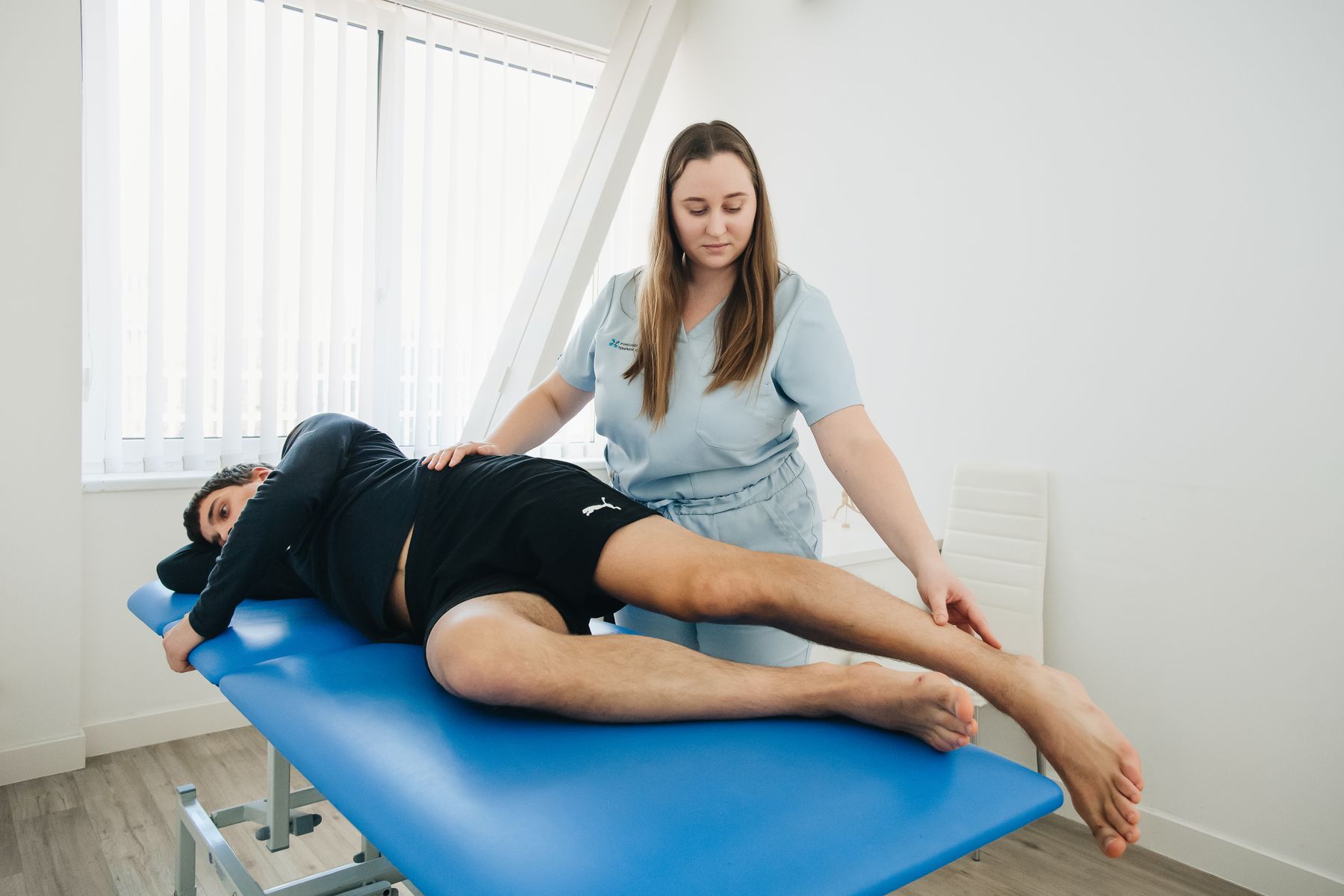
Treating hip arthritis at RISE starts with measurement, because the honest evidence above means a generic hip program is not good enough — we need to know which of your losses is actually limiting you. Every session is a full 45 minutes, one-on-one with the same Doctor of Physical Therapy, which is what makes it possible to load a stiff hip properly, watch how it responds, and adjust the same day rather than three weeks later.
Measure the joint, not the impression: goniometric hip rotation, flexion and extension, hip abductor and extensor strength, a 30-second sit-to-stand, and your current tolerated walking distance — all recorded so we can show you what changed.
Load the hip progressively: hip abductor, extensor, and quadriceps strengthening built up over weeks, because strength is the loss that most reliably tracks with function and it is the one that responds to training.
Restore what rotation is available: joint mobilization, soft tissue work through the hip flexors and lateral hip, and end-range mobility work — used to open a window for loading, not as the treatment itself.
Manage the walking dose: a specific weekly plan for distance, terrain, and frequency, using the 24-hour rule, so the hip is worked without being flared.
Support the levers outside the joint: weight management referral where it is welcome, a cane or trekking pole on the right side when it genuinely helps, and coordination with your physician on medication and imaging.
Prepare for surgery if it comes: pre-operative strength work and a rehab plan already in place, so a hip replacement starts from the best possible baseline rather than the worst.
Rotation, strength, sit-to-stand, and walking tolerance measured and written down, plus a red-flag screen and a clear answer on whether imaging or a physician opinion belongs in the plan.
02 — LOAD
Strength before stretching
Progressive hip and trunk strengthening at a dose the joint tolerates, manual therapy used to open range for that loading, and a walking plan with actual numbers in it.
03 — SUSTAIN
Keep the gains, plan the years
A maintenance program you will actually do, re-measurement at intervals, and an honest read on whether conservative care is still working or the surgical conversation has arrived.
What to expect at your first visit
The functional history. Where the pain sits, how far you can walk before it starts, what stiffness does in the morning, and which specific tasks — socks, stairs, the car, the yard — have quietly disappeared from your week.
A measured hip exam. Rotation, flexion and extension range compared side to side, hip abductor and extensor strength testing, gait observation, and the tests that separate joint arthritis from lateral hip tendon pain and referred back pain.
A red-flag screen. The list above, plus a review of medications, other joints, and general health — so anything that needs a physician gets identified on day one rather than week six.
A frank conversation about expectations. What the evidence supports, what it does not, and what a realistic three-month outcome looks like for your hip specifically. No cure language, no scan-based doom.
A plan with numbers in it. Two to four exercises you can actually do, a walking dose for the week, and the measurements we will retest so progress is visible. Most hips are seen every one to two weeks over 8–12 weeks rather than three times a week indefinitely.
Frequently asked questions
Is walking good for hip arthritis?+
Usually yes. Walking is one of the gentlest ways to keep loading an arthritic hip, and the working rule we give patients is that soreness which settles within about 24 hours is acceptable, while soreness still there the next evening means the dose was too big. What tends to backfire is the all-or-nothing pattern — three miles on a good day, then three days of limping. Twenty minutes most days beats an hour twice a week for almost every hip we see. If level walking consistently leaves you worse the following morning, that is a reason to have the hip assessed rather than a reason to stop moving, because a hip that cannot tolerate flat ground usually has a measurable strength or range-of-motion problem underneath it.
Why does hip arthritis hurt in the groin — and sometimes in the knee?+
Hip osteoarthritis is felt most often as deep pain in the groin, and it can radiate into the buttock, the front of the thigh, and as far as the knee, because the hip joint and the knee share nerve supply.[1] That referral pattern is why some people arrive convinced their knee is the problem, and why a painful knee with unremarkable imaging should always prompt an examination of the hip above it. Pain over the bony point on the outside of the hip is a different story — that is more often gluteal tendon or bursal irritation than joint arthritis.
Can hip arthritis be reversed?+
No. Nothing currently available regrows hip cartilage, and any clinic promising to reverse your arthritis is overselling. What genuinely can change is how much the joint hurts and how much you can do with it. Pooled trial data show exercise therapy produces small improvements in hip pain and function that are still measurable six to nine months later,[3] and in one randomised trial the group that added supervised exercise to education kept their own hip about two years longer before replacement.[5] Those are real, worthwhile gains. They are not a cure, and we would rather say that plainly than let you find out later.
How is hip arthritis different from hip bursitis or impingement?+
Location, age, and the range-of-motion exam usually separate them. Hip osteoarthritis is deep groin pain in a joint that has measurably lost rotation, most often after age 50. Greater trochanteric pain — commonly called hip bursitis — is tenderness on the bony point at the side of the hip, typically worse lying on that side at night, with hip rotation preserved. Femoroacetabular impingement is more often a younger, athletic person's groin pain with a pinching sensation at the end of deep flexion. They overlap more than the labels suggest, and impingement in your twenties can be part of the story of arthritis in your fifties, which is why we examine rather than assume.
Do I need an X-ray to diagnose hip arthritis?+
Not in order to start treatment. Hip osteoarthritis is diagnosed clinically from the pattern — groin pain, morning stiffness that eases inside 30 minutes, and lost internal rotation on examination.[1] Images and symptoms also line up poorly: among US adults aged 45 and over, about 27% have radiographic signs of hip osteoarthritis while roughly 9.2% have the symptomatic disease, so a film can show changes in a hip that does not hurt.[1] An X-ray earns its place when we are heading toward a surgical conversation, when the presentation is atypical, or when a red flag is present. It is not a prerequisite for starting exercise.
Do I need a referral for hip arthritis physical therapy in Idaho?+
No. Idaho has direct access to physical therapy, so you can book an evaluation at RISE in Boise or Nampa without seeing a physician first. Two caveats worth knowing. Some plans — commonly Medicare, Medicaid, and Tricare — still require a physician referral for the visit to be covered, and we verify that with your plan before your first appointment. And if your hip turns out to need imaging or an orthopedic opinion, we will tell you and help you get there; direct access means the assessment happens this week rather than next month, not that everything gets managed in our clinic.
Does insurance cover physical therapy for hip arthritis?+
Most major medical plans cover physical therapy for hip osteoarthritis, both as conservative care and as rehabilitation before or after a hip replacement. RISE is in-network with most major insurance plans in Idaho — see our insurance list or send us your details and we will verify your coverage, any visit limits, and whether your plan requires a referral before your first appointment.
Carson is a co-founder of RISE Physical Therapy and treats orthopedic, sports, and tendon conditions with a hands-on, movement-first approach. He earned his Doctorate of Physical Therapy from Pacific University in Oregon. Meet the full team →
Hall M, Lawford BJ, Hinman RS, Dobson F, Spiers L, Kimp A, French HP, Reichenbach S, Hernandez-Molina G, Bennell KL. Exercise for osteoarthritis of the hip. Cochrane Database of Systematic Reviews, 2026;(7):CD007912. cochranelibrary.com/cdsr/doi/10.1002/14651858.CD007912.pub3
Teirlinck CH, Verhagen AP, van Ravesteyn LM, et al. Effect of exercise therapy in patients with hip osteoarthritis: A systematic review and cumulative meta-analysis. Osteoarthritis and Cartilage Open, 2023;5(1):100338. pmc.ncbi.nlm.nih.gov/articles/PMC9932106
Bennell KL, Egerton T, Martin J, et al. Effect of Physical Therapy on Pain and Function in Patients With Hip Osteoarthritis: A Randomized Clinical Trial. JAMA, 2014;311(19):1987–1997. pubmed.ncbi.nlm.nih.gov/24846036
Svege I, Nordsletten L, Fernandes L, Risberg MA. Exercise therapy may postpone total hip replacement surgery in patients with hip osteoarthritis: a long-term follow-up of a randomised trial. Annals of the Rheumatic Diseases, 2015;74(1):164–169. pubmed.ncbi.nlm.nih.gov/24255546
Kolasinski SL, Neogi T, Hochberg MC, et al. 2019 American College of Rheumatology/Arthritis Foundation Guideline for the Management of Osteoarthritis of the Hand, Hip, and Knee. Arthritis & Rheumatology, 2020;72(2):220–233. pubmed.ncbi.nlm.nih.gov/31908149
 Medically reviewed by Dr. Carson Bailey, PT, DPT · August 2026