The herniations that look worst on a scan are the ones most likely to shrink on their own. The job is to protect the nerve, load the spine well, and know the short list of signs that belong with a surgeon.
A herniated disc is a tear in the tough outer ring of a spinal disc that lets softer material from the centre push outward, where it can compress or chemically irritate a nearby nerve root — which is why the pain is so often felt in the leg rather than the back. Most cases resolve without an operation: reviewed clinical guidance puts improvement at roughly 90% within about six weeks of conservative care,[2] and follow-up imaging shows extruded herniations shrinking on their own in roughly 60% to 70% of cases.[3] RISE Physical Therapy treats herniated discs one-on-one in 45-minute sessions in Boise and Nampa, Idaho, screening at the first visit for the small minority of presentations that belong with a surgeon instead.
What is a herniated disc?
A herniated disc is a tear in the annulus — the tough, laminated outer ring of a spinal disc — that allows some of the gel-like nucleus at the centre to displace outward. Nothing has slipped. Each disc is bonded to the vertebrae above and below it and cannot slide anywhere, so the popular name "slipped disc" describes a mechanism that does not exist. A bulge in a tyre wall is a much closer analogy than a bone out of place.
Radiology reports grade this on a spectrum, and the words are worth knowing because they turn out to predict how the story ends. A bulge is the whole disc rim extending slightly beyond the vertebral edge. A protrusion is a focal outpouching still contained by the outer fibres. An extrusion is disc material that has pushed through the annulus. A sequestration is a fragment that has separated from the disc entirely. Those are descriptions of shape on a scan, not descriptions of how much it hurts — a distinction that matters more than almost anything else on this page.
Lumbar herniations are common and they cluster. The reported annual incidence is roughly 5 to 20 cases per 1,000 adults, the average age of onset is about 41, men are affected roughly twice as often as women, and the bottom two levels of the lumbar spine — L4–L5 and L5–S1 — account for approximately 95% of cases in adults aged 25 to 55.[2] Those two levels sit exactly where the spine takes the most bending and loading, which is not a coincidence.
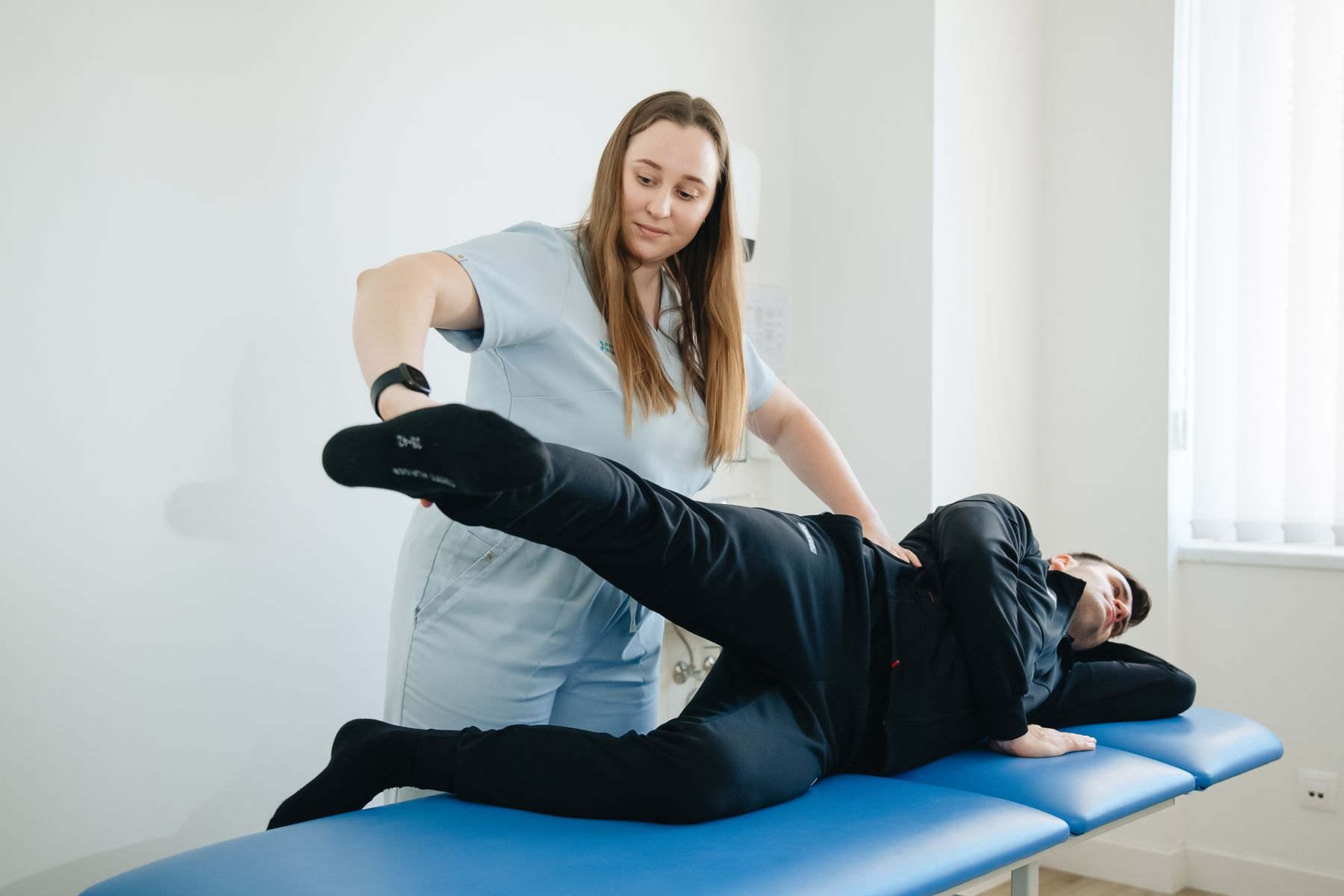
Nerve tension testing — raising the straight leg to see at what angle familiar leg symptoms reproduce — is one of the clinical findings that tells us whether a disc finding on a scan actually explains what you feel.
What does a herniated disc feel like?
A herniated disc most often announces itself as leg pain rather than back pain — a sharp, electric or burning line running from the buttock down the back or outside of the thigh, sometimes into the calf, foot or toes. When a nerve root is irritated, the symptoms show up in that nerve's territory, which is why the leg can hurt considerably more than the spine that caused it. Typical features include:
Leg pain that outweighs the back pain, following a defined strip rather than the whole limb
Numbness or pins and needles in a specific area — the outside of the calf, the top of the foot, the sole, one or two toes
Symptoms that spike with sitting, bending forward, coughing or sneezing, all of which raise pressure through the disc
Weakness — trouble rising onto the toes, walking on the heels, or a foot that catches on kerbs and stairs
A pattern that moves during the day, drifting further down the leg with some postures and back toward the spine with others
Relief in one specific position — often standing, walking, or lying with the hips supported — that becomes an important clue for treatment
Worth saying plainly: a great many disc herniations produce no symptoms at all and are found incidentally. The presence of a herniation and the presence of pain are two separate facts that have to be connected by an examination, not assumed.
Does a herniated disc heal on its own?
Most herniated discs do improve on their own, and a substantial share of them physically shrink. Reviewed clinical guidance places improvement at roughly 90% of symptomatic cases within about six weeks of conservative management, and resolution in more than 85% by eight to twelve weeks.[2] That is the symptom side. The tissue side is more interesting.
A 2026 review of the spontaneous resorption literature reports that roughly half to two-thirds of herniated lumbar discs show at least partial shrinkage on serial scans during non-surgical care, with the odds strongly dependent on what type of herniation it is: sequestered fragments regress in as many as 80% to 90% of selected cohorts, extrusions in approximately 60% to 70%, and contained protrusions well under half the time, possibly nearer 30% to 40%.[3] The most rapid change happens in the first few months, with meaningful reduction commonly visible between three and six months and, by a year, extruded material typically resolved or dramatically smaller.[3]
Read that ordering again, because it inverts what patients expect. The herniations that look most alarming in a report — the big extrusions, the free fragments — are the ones most likely to disappear, apparently because material that has broken through into the blood supply gets recognised and cleared, while a contained bulge sits protected behind intact fibres. Larger initial volume, younger age, lower body mass index and the absence of chronic degenerative endplate changes all associate with better resorption.[3]
Two honest limits. That review is narrative rather than a pooled meta-analysis, and it draws on studies using different imaging protocols, follow-up windows and definitions of what counts as resorption, so the percentages are ranges rather than precise probabilities.[3] And shrinkage on a scan and feeling better do not move in lockstep — people get better without their disc changing, and discs shrink in people who still hurt. Resorption is a reason for realistic optimism, not a target to chase with repeat imaging.
Why doesn't your MRI match how you feel?
Disc findings on an MRI are so common in people with no symptoms that a scan alone cannot tell you where your pain is coming from. The best evidence on this is a systematic review of 33 studies reporting imaging in 3,110 asymptomatic individuals — people with no back pain at the time of the scan. Disc protrusions were present in 29% of 20-year-olds, rising to 43% of 80-year-olds. Simple disc bulges appeared in 30% at age 20 and 84% at age 80. Disc degeneration ran from 37% of 20-year-olds to 96% of 80-year-olds.[1]
The authors' conclusion is the one that should follow any lumbar MRI report into the room: many of these features are part of normal ageing and have to be interpreted in the context of the clinical picture rather than read as a diagnosis.[1] A scan becomes genuinely informative when the level and side it identifies line up with the pattern of your symptoms and the findings on examination — reflexes, strength, sensation, nerve tension testing — or when a decision about injection or surgery is actually being made.
This is not an argument against imaging, and it is emphatically not an argument for ignoring red flags. It is an argument against letting a phrase like "L5–S1 disc protrusion" become an identity. Plenty of people in Boise and Nampa are walking around comfortably today with the exact finding written on someone else's report.
What does the research say about physical therapy for a herniated disc?
The trial evidence supports exercise-based physical therapy for lumbar disc herniation, while being smaller and messier than the confident claims made for it online. Both halves of that sentence belong in the same paragraph.
META-ANALYSIS · 2025
Across 8 randomised trials and 611 patients with lumbar disc herniation, exercise therapy outperformed control on pain, Oswestry disability scores, range of motion and quality of life.
Pooling 55 randomised trials and 4,311 patients, physical therapy after lumbar disc surgery improved pain, function and quality of life — and activity restriction showed no substantial advantage.
The first card is a genuine finding with genuine caveats attached. Heterogeneity between the pooled trials was very high for both the pain and disability outcomes, only three of the eight studies reported any follow-up beyond the treatment period, most delivered exercise as part of a combination of interventions rather than alone, and the trials excluded severe cases, surgical patients and people over 65.[5] So the reasonable reading is that exercise-based care is a sound first-line choice for the typical presentation, with the size of the benefit and its durability less certain than the p-values suggest, and little to say about the most severe end of the spectrum.
The second card matters because roughly a third to a half of people with severe sciatica do end up having surgery, and what happens afterwards is not incidental. That synthesis found exercise aimed at back endurance, flexibility and strength generally effective after discectomy — with neural mobilisation exercises the noted exception — and found no substantial advantage to restricting activity, while the optimal timing for starting therapy remains debated.[6] The practical translation is that whether or not you have an operation, the rebuilding is the same job.
When is surgery for a herniated disc worth it?
For most people with disc-related sciatica, surgery buys faster relief rather than a better destination. The clearest test of that came from a randomised trial of 283 patients whose sciatica had lasted an average of about nine weeks, assigned either to early surgery or to prolonged conservative care with surgery held in reserve. Early surgery did relieve leg pain sooner. But at five years the groups were statistically indistinguishable on disability, leg pain and back pain, and unsatisfactory recovery was reported by 17% of the early-surgery group against 18% of the conservative group.[4]
The crossover numbers are the part worth holding onto. Of those assigned to conservative care, 39% had undergone surgery by one year and 46% by five years, so this was never a comparison of surgery against no surgery — it compared operating early with waiting to see who still needed it, and slightly more than half never did.[4] Two further honesties from the same paper: 18% of patients were lost to follow-up by five years, and roughly a fifth of everyone in the trial, in both arms, described their recovery as unsatisfactory at that point. Neither route is a guarantee.
None of that applies to the situations where surgery is not a preference question. Cauda equina syndrome is a surgical emergency, and progressive or severe motor weakness needs prompt surgical assessment rather than a course of exercises.[2] Outside those, choosing an operation because you cannot function and want relief sooner is a legitimate decision made with a spine surgeon — the evidence simply says that a few weeks of good conservative care first is unlikely to cost you the outcome.
What herniated disc symptoms need urgent care?
A small number of symptoms turn a herniated disc from a physical therapy problem into a same-day medical one. Go to an emergency department, rather than waiting for an appointment, for any of these:
New difficulty passing urine, or losing the normal urge to go — urinary retention is the most common early sign of cauda equina syndrome
Loss of bladder or bowel control, or numbness in the groin, genitals or the area you sit on (saddle anaesthesia)
Weakness in both legs, or weakness anywhere that is clearly getting worse week over week — particularly when it is painless[2]
Back pain with fever, chills, unexplained weight loss, or a history of cancer
Back and leg symptoms that began with significant trauma — a fall, a crash
Cauda equina syndrome — compression of the nerve bundle at the base of the spinal cord — is uncommon, but it is treated urgently because the damage can become permanent. Screening for it is a standing part of every spine evaluation we do, and it is the reason we ask questions that seem unrelated to your leg.
How we treat a herniated disc at RISE
Herniated disc care at RISE starts by establishing which nerve is involved, whether it is getting better or worse, and whether you should be here at all. After that the plan is built around direction — the positions and movements that pull your symptoms out of the leg and back toward the spine — and then around rebuilding tolerance for the things that set it off. A full 45 minutes one-on-one with the same Doctor of Physical Therapy is what makes a proper neurological exam and an honest weekly recheck possible rather than aspirational.
Screen before we treat: reflexes, strength, sensation and nerve tension testing at the first visit, plus the red-flag questions — so anything needing a physician is identified on day one, not in a month.
Map the pattern, not just the pain score: where symptoms sit in the leg, and what moves them closer to the spine, becomes the measurement we track session to session.
Find your direction: people with herniations at the same level often respond to opposite positions, so the loading direction is tested on you rather than assumed from the report.
Read imaging alongside the exam: disc protrusions appear in 29% of pain-free 20-year-olds, so a scan finding earns its place in the plan only when it matches what the examination shows.
Rebuild the load, not just settle it: graded hip and trunk strengthening and a return to real lifting, sitting and sport, because calming symptoms without rebuilding capacity is how the next flare gets booked.
Escalate honestly: weakness that progresses, or severe pain that has not shifted by our agreed review point, means a call to your physician rather than another six visits.
Neurological examination, nerve tension testing and red-flag screening, so we know the level involved and whether physical therapy is the right room for you at all.
02 — CALM
Get symptoms out of the leg
Symptom-guided positioning and loading, manual therapy and activity adjustments aimed at moving pain toward the spine — the change we track weekly rather than guess at.
03 — REBUILD
Make the back hard to re-irritate
Progressive hip and trunk strengthening, hinge and lifting mechanics, and a graded return to sitting, driving, work and sport with a program you keep afterwards.
What to expect at your first visit
The history that actually sorts this out. Where the symptoms sit in the leg, what has changed since they started, what makes them travel further down and what pulls them back — plus the red-flag questions about bladder, bowel and saddle sensation.
A neurological examination. Reflexes, muscle strength by nerve level, sensation and nerve tension testing, so the involved level is established from your body rather than inferred from a report.
Your imaging read in context. If you have had an MRI, we go through it alongside the exam findings and tell you plainly which parts of it explain your symptoms and which parts are ordinary for your age.
Testing your direction. We trial the positions and movements that move symptoms toward the spine and identify the ones that do the opposite, then build the home plan around what your leg actually did in the room.
A plan with a review point. A short home program, clear rules for what to do on a bad day, and an agreed timeframe by which we expect to see change — with a referral back to your physician if it does not arrive.
Frequently asked questions
How long does a herniated disc take to heal?+
Most symptomatic herniated discs settle substantially within about six weeks, and reviewed clinical guidance puts resolution with conservative management at more than 85% by eight to twelve weeks.[2] The disc material itself is on a slower clock than the symptoms: shrinkage is fastest in the first few months, clearly visible on repeat scans between three and six months, and by a year most extruded herniations have either resolved or reduced dramatically.[3] Two things make people think they are the exception. The first is that recovery is rarely linear — good weeks and bad weeks are the normal shape of it. The second is that a leg that has been irritated for months can stay sensitive after the mechanical problem has improved, which is a different problem with a different fix. At RISE we set a review point rather than a promise: if the pattern has not shifted in the direction we expected within a few weeks, we change the plan or send you back to your physician rather than repeat it louder.
Can a herniated disc heal without surgery?+
Yes, and it is the usual outcome. Reviewed imaging follow-up shows roughly half to two-thirds of herniated lumbar discs shrinking at least partly on their own during non-surgical care, and the type of herniation predicts the odds: sequestered fragments, where a piece separates completely, regress in as many as 80% to 90% of cases in selected cohorts, extrusions in roughly 60% to 70%, and contained protrusions well under half the time.[3] That ordering surprises most people, because the herniations that look most alarming on a report are the ones most likely to disappear. The caveat worth stating is that these figures come from heterogeneous studies with different imaging protocols and different definitions of resorption, and shrinkage on a scan and feeling better do not track each other perfectly. Surgery remains the right answer for a minority — progressive weakness, cauda equina signs, or severe pain that will not settle.
Do I need an MRI for a herniated disc?+
Usually not at the start, because the scan rarely changes what the first several weeks of treatment look like. The reason is that disc findings are extremely common in people with no pain at all: in a systematic review of 33 studies covering 3,110 asymptomatic individuals, disc protrusions were present in 29% of 20-year-olds and 43% of 80-year-olds, and plain disc bulges in 30% and 84% of the same age groups.[1] So a report describing a protrusion at L5–S1 has not, by itself, found the cause of your pain. What makes imaging genuinely useful is when the level and side on the scan match the pattern of your symptoms and your neurological exam, or when a decision about surgery or an injection is actually on the table. Imaging is also the right call early when red flags are present. If you have already had a scan, bring it — we will read it alongside the exam rather than instead of it.
What should I avoid doing with a herniated disc?+
There is no universal blacklist, and the honest answer is that the exercises and positions to avoid are the ones that push your symptoms further down the leg. That directional rule is more useful than a list, because two people with herniations at the same level often respond to opposite positions. Prolonged sitting, repeated end-range bending and heavy lifting with a rounded back are the usual early aggravators, and long car trips down I-84 are a common reason someone arrives worse than they left. What is not supported is resting it out: evidence synthesis after lumbar disc surgery found that activity restriction carried no substantial advantage, and the same principle applies before surgery is ever on the table.[6] The working rule we teach is that symptoms centralizing — moving from the calf toward the back — is a green light, and symptoms travelling further down the leg is a signal to change what you are doing that day.
Is surgery better than physical therapy for a herniated disc?+
For most people surgery buys speed rather than a better final result. In a randomised trial of 283 patients with sciatica of about nine weeks' duration, early surgery relieved leg pain faster than prolonged conservative care — but by five years the two groups were statistically indistinguishable on disability, leg pain and back pain, and unsatisfactory recovery was reported by 17% of the early-surgery group and 18% of the conservative group. Notably, 39% of the conservative group had crossed over to surgery by one year, rising to 46% by five years, so this is not a comparison of surgery against no surgery but of operating early against waiting to see who still needs it.[4] That is exactly the choice most people face, and it is a legitimate personal one: faster relief has real value if you cannot function. What the trial argues against is the fear that waiting a few weeks costs you the outcome.
When is herniated disc pain an emergency?+
Go to an emergency department the same day if you develop new difficulty passing urine or lose the normal urge to go, lose control of your bladder or bowels, or develop numbness in the groin, genitals or the area you would sit on. Together these suggest cauda equina syndrome, a compression of the nerve bundle at the base of the spine that is treated as a surgical emergency because delay risks permanent damage.[2] Progressive weakness in one or both legs — a foot that increasingly slaps or catches, or leg weakness that is getting worse week over week — needs urgent physician assessment rather than an appointment next month, particularly when it is painless. Back pain with fever, unexplained weight loss, a history of cancer, or significant trauma also belongs with a physician first. These presentations are uncommon, but screening for them is part of every evaluation we do.
Do I need a referral for physical therapy for a herniated disc in Idaho?+
No. Idaho is a direct-access state, so you can book an evaluation at RISE in Boise or Nampa without seeing a physician first, and for suspected disc-related leg pain that is often the faster route to being examined properly. Two practical exceptions. Some plans — commonly Medicare, Medicaid and Tricare — require a physician referral for coverage regardless of state law, and we check that with your plan before your first appointment. And direct access does not mean we treat everything that walks in: part of a first visit is deciding whether you belong in physical therapy at all, and progressive weakness, red-flag findings or a suspected non-spinal cause get routed to a physician the same day. If you already have a referral or a recent MRI, bring both.
Does insurance cover physical therapy for a herniated disc?+
Physical therapy for a herniated disc is covered by most major medical plans and by Medicare, and it is typically the treatment plans expect to see attempted before they will authorise imaging, injections or a surgical consult. The details that matter are your visit allowance, your deductible and coinsurance, and whether your plan requires a referral or prior authorisation. RISE is in-network with most major insurance plans in Idaho — see our insurance list or send us your details and we will verify your benefits before your first appointment, so you know what a full course of care costs before you start one rather than midway through.
Carson is a co-founder of RISE Physical Therapy and treats orthopedic, sports, and spine conditions with a hands-on, movement-first approach. He earned his Doctorate of Physical Therapy from Pacific University in Oregon. Meet the full team →
SOURCES
Brinjikji W, Luetmer PH, Comstock B, et al. Systematic Literature Review of Imaging Features of Spinal Degeneration in Asymptomatic Populations. American Journal of Neuroradiology, 2015;36(4):811–816. pmc.ncbi.nlm.nih.gov/articles/PMC4464797
Stretanski MF, Hu Y, Mesfin FB. Disk Herniation. StatPearls, StatPearls Publishing; updated 2025. ncbi.nlm.nih.gov/books/NBK441822
Golubović J, et al. Spontaneous Resorption of Lumbar Disc Herniation: A Narrative Review of Pathophysiology, Predictive Factors, and Clinical Decision-Making. NeuroSci, 2026;7(2):30. pmc.ncbi.nlm.nih.gov/articles/PMC13010770
Lequin MB, Verbaan D, Jacobs WCH, Brand R, Bouma GJ, Vandertop WP, Peul WC. Surgery versus prolonged conservative treatment for sciatica: 5-year results of a randomised controlled trial. BMJ Open, 2013;3(5):e002534. pmc.ncbi.nlm.nih.gov/articles/PMC3657649
Du X, Cui H, Peng J, Wu M, Xu Y, Mo Y, Ye C. Clinical efficacy of exercise therapy for lumbar disc herniation: a systematic review and meta-analysis of randomized controlled trials. Frontiers in Medicine, 2025;12:1531637. ncbi.nlm.nih.gov/pmc/articles/PMC11985520
Brotis AG, et al. Physical therapies after surgery for lumbar disc herniation — evidence synthesis from 55 randomized controlled trials (RCTs) and a total of 4,311 patients. Brain and Spine, 2025. pubmed.ncbi.nlm.nih.gov/40165991
 Medically reviewed by Dr. Carson Bailey, PT, DPT · September 2026