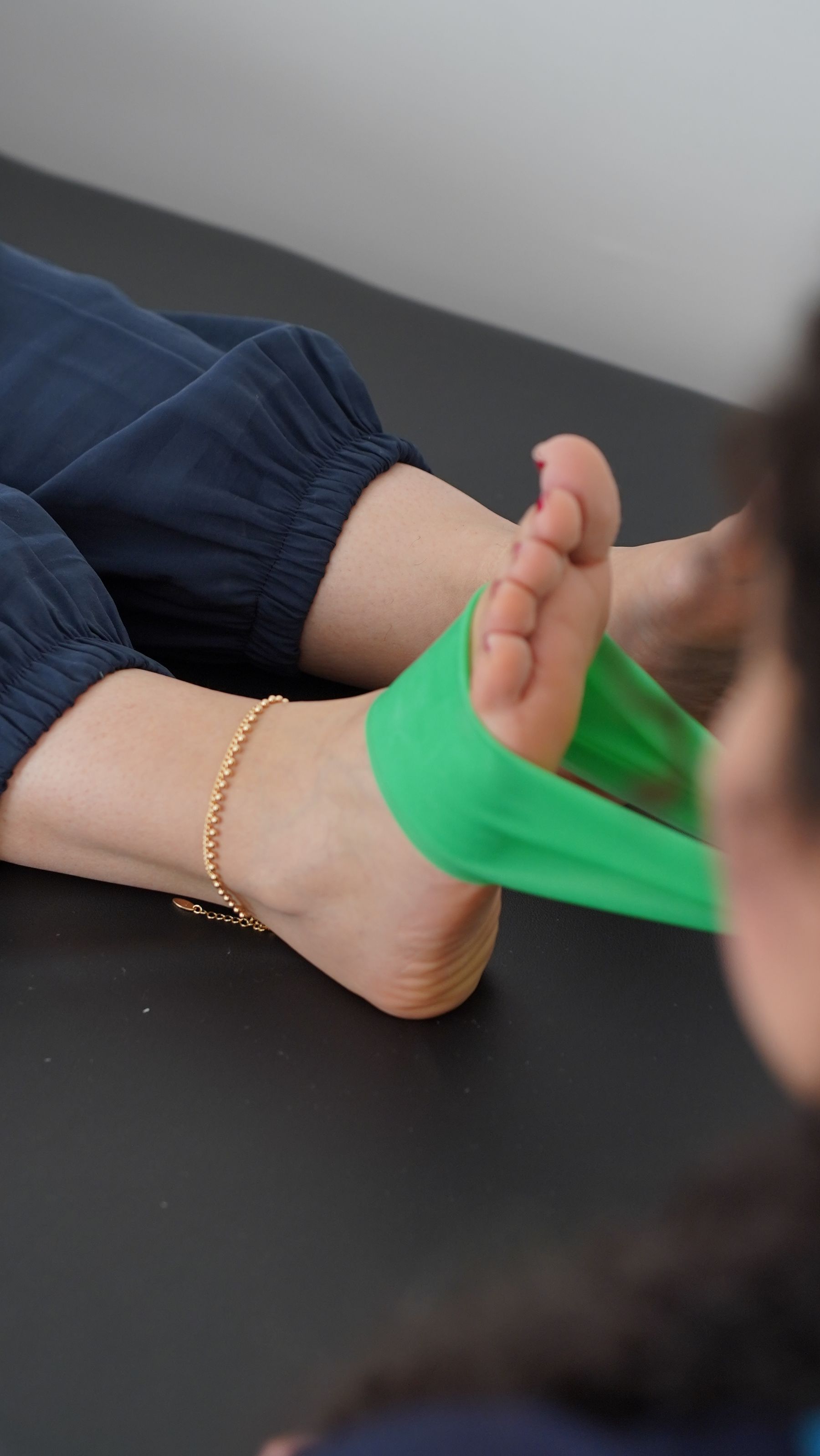
A rolled ankle that's "just a sprain" is the most re-injured injury in sports. Rehab it right the first time — one-on-one, with a plan built to keep it from happening again.
An ankle sprain is a stretch or tear of the ankle's stabilizing ligaments, most often on the outside of the joint after the foot rolls inward. Modern care means early protected movement and exercise — not weeks in a boot — and exercise-based rehab lowers the odds of spraining it again by roughly 40%. RISE Physical Therapy treats ankle sprains one-on-one in 45-minute sessions in Boise and Nampa, Idaho, with no referral required.
What is an ankle sprain?
An ankle sprain is an injury to the ligaments that hold the ankle bones together — usually the lateral ligament complex on the outside of the joint, damaged when the foot rolls inward under body weight. It's among the most common musculoskeletal injuries in sport and daily life, from basketball courts and trail runs in the Boise foothills to a bad step off a curb.
Sprains are graded 1 to 3: grade 1 is a stretch with microscopic tearing, grade 2 a partial tear with clear swelling and bruising, grade 3 a complete tear with marked instability. But the grade only tells part of the story. A sprain also disrupts proprioception — the ankle's position-sense and reaction system — and that invisible damage is why so many "healed" ankles give way again months later.
Symptoms: when should you seek help?
Most sprains hurt immediately and swell within hours. Book an evaluation if you notice:
Pain and swelling over the outside (or less commonly inside) of the ankle
Bruising that spreads down toward the toes over a few days
Limping or difficulty bearing full weight
A wobbly, untrustworthy feeling on uneven ground
An ankle that has now sprained more than once — that's a pattern worth breaking
Get assessed promptly — including screening under the Ottawa Ankle Rules for possible fracture — if you can't take four steps, have bone tenderness at the back edge of either ankle bone or over the midfoot, or your foot feels numb or cold.
Early protected movement — not strict immobilization — is the evidence-based start for most ankle sprains.
What does the research say about ankle sprain treatment?
The evidence here is unusually clear. An overview of systematic reviews in the British Journal of Sports Medicine found strong evidence that exercise therapy reduces the risk of recurrent ankle sprain and improves function after injury.[1] The international clinical guideline for ankle sprains reaches the same conclusion from the treatment side: supervised exercise-based programs are preferred over passive treatment and immobilization, and surgery is reserved for the minority of cases that fail comprehensive rehab.[2]
The reinjury numbers make the case concrete: in a 2022 meta-analysis of randomized trials, exercise-based rehabilitation cut the odds of re-spraining at 12 months by about 40% compared with usual care.[3] The old formula of rest, ice, and waiting doesn't deliver that — balance training, strengthening, and a graded return to cutting and landing do. Icing and compression still have a supporting role for comfort and swelling in the first days; they're just not the treatment.
How we treat ankle sprains at RISE
Ankle care at RISE has two jobs: get this sprain better, and make the next one far less likely. Every session is 45 minutes one-on-one with the same Doctor of Physical Therapy.
Fracture and severity screen: Ottawa rules, ligament testing, and a check of the high ankle and midfoot make sure nothing is missed.
Early protected motion: weight-bearing, gentle range, and swelling management start immediately — matched to the sprain's grade.
Balance and reaction training: progressive proprioceptive work rebuilds the reflexes that actually prevent the next roll.
Return-to-sport criteria: hop tests, strength symmetry, and sport-specific drills decide when you're ready — not the calendar.
Fracture screening and ligament testing establish what's injured and how badly — the plan follows from there.
02 — TREAT
Move early, protect smart
Protected weight-bearing, swelling control, and early range work get you walking normally as fast as the tissue allows.
03 — REBUILD
Make it sprain-proof
Balance, strength, and landing mechanics are trained past baseline — because the goal is the last sprain, not just this one.
What to expect at your first visit
Your story first. How the ankle rolled, whether you heard a pop, what happened in the first hours, and any previous sprains on either side.
A safety screen. Ottawa Ankle Rules and a high-ankle and midfoot check — if imaging is warranted, we say so and help arrange it.
Grading and baseline testing. Ligament testing, swelling measurement, and — as tolerated — balance and strength baselines to track against.
Treatment on day one. Swelling management, taping or bracing if useful, and your first mobility and weight-bearing exercises.
A milestone map. You'll know what week two, week four, and return-to-sport testing should look like, so progress is visible from the start.
Frequently asked questions
Should I walk on a sprained ankle or stay off it?+
For most sprains, early protected movement beats strict rest. Evidence-based guidelines recommend functional treatment — early weight-bearing as tolerated, sometimes with a brace — over immobilization, because ligaments and balance recover better with controlled load.[2] Severe pain, inability to take four steps, or bony tenderness are signs you need an X-ray first.
Do I need an X-ray after rolling my ankle?+
Only sometimes. Clinicians use the Ottawa Ankle Rules: an X-ray is warranted if there's bone tenderness at specific points on the ankle or foot, or if you can't bear weight for four steps both right after the injury and at evaluation. Your physical therapist screens these at the first visit and refers you for imaging if they're positive.
Why does my ankle keep spraining over and over?+
Because a sprain damages more than ligament — it disrupts the balance and reaction system that protects the joint, and that system doesn't fully recover on its own. Without targeted rehab, many people develop chronic ankle instability. Exercise-based rehabilitation reduces the risk of recurrent sprain — pooled trial data show roughly 40% lower reinjury odds at 12 months[3] — which is exactly what a structured program targets.
How long does an ankle sprain take to heal?+
Mild (grade 1) sprains often feel good in 1–3 weeks, moderate (grade 2) sprains in 3–6 weeks, and severe (grade 3) sprains can take 8–12 weeks or more. Feeling good and being ready are different things, though — pain resolves before balance and strength do, which is why so many ankles are resprained in the months after everything "felt fine."
Do I need a referral for ankle sprain treatment in Idaho?+
No. Idaho is a direct-access state, so you can book an ankle evaluation at RISE without a physician referral. Some insurance plans — commonly Medicare, Medicaid, and Tricare — require a referral for coverage, and we'll verify your plan's requirements before your first visit.
Does insurance cover physical therapy for an ankle sprain?+
Most major medical plans cover physical therapy for ankle sprains. RISE is in-network with most major insurance plans in Idaho — check our insurance list or contact us and we'll verify your coverage before your first appointment.
Carson is a co-founder of RISE Physical Therapy and treats orthopedic, sports, and foot & ankle conditions with a hands-on, movement-first approach. He earned his Doctorate of Physical Therapy from Pacific University in Oregon. Meet the full team →
SOURCES
Doherty C, Bleakley C, Delahunt E, Holden S. Treatment and Prevention of Acute and Recurrent Ankle Sprain: An Overview of Systematic Reviews With Meta-analysis. British Journal of Sports Medicine, 2017. bjsm.bmj.com/content/51/2/113
Vuurberg G, et al. Diagnosis, Treatment and Prevention of Ankle Sprains: Update of an Evidence-Based Clinical Guideline. British Journal of Sports Medicine, 2018. pubmed.ncbi.nlm.nih.gov/29514819
Wagemans J, et al. Exercise-Based Rehabilitation Reduces Reinjury Following Acute Lateral Ankle Sprain: A Systematic Review Update With Meta-analysis. PLOS One, 2022. ncbi.nlm.nih.gov/pmc/articles/PMC8824326
 Medically reviewed by Dr. Carson Bailey, PT, DPT · August 2026