That stiff, aching cord above your heel isn't wear you have to accept — tendons adapt when they're loaded right. Progressive Achilles rehab, coached one-on-one.
Achilles tendinopathy is overload-related irritation and degeneration of the body's largest tendon, causing morning stiffness and pain with running, hills, and stairs. The best-supported treatment is a progressive 12-week loading program — eccentric or heavy slow resistance exercise — not rest. RISE Physical Therapy treats Achilles tendinopathy one-on-one in 45-minute sessions in Boise and Nampa, Idaho, with no referral required.
What is Achilles tendinopathy?
Achilles tendinopathy is a load-capacity problem of the Achilles tendon — the thick cord connecting your calf muscles to your heel bone that absorbs and returns forces of several times body weight with every running stride. When training load rises faster than the tendon can adapt, its collagen structure becomes disorganized and painful. Despite the older name "Achilles tendinitis," research shows the dominant process is degeneration and failed repair rather than pure inflammation, which is why anti-inflammatory strategies alone rarely fix it.
The condition comes in two locations that matter for treatment: midportion tendinopathy, felt 2–6 cm above the heel bone, and insertional tendinopathy, felt where the tendon attaches to the heel itself. Insertional cases are aggravated by stretching and uphill work, so the exercise prescription changes — one of several reasons an accurate assessment beats a generic protocol from the internet. In Dutch general-practice data, midportion Achilles tendinopathy alone accounts for about 1.85 new cases per 1,000 registered patients per year, with the highest rates in adults in their 40s and 50s.[1]
Symptoms: when should you seek help?
Achilles tendinopathy usually announces itself gradually. Book an evaluation if you notice:
Stiffness and pain in the tendon with your first steps of the morning
Pain that "warms up" during a run, then returns worse afterward or the next day
A tender, sometimes thickened spot above the heel, or pain right at the heel bone
Pain with hills, stairs, jumping, or picking up the pace
A tendon that limits how far or how often you can run, hike, or play
Sudden sharp pain with a pop, a sensation of being kicked in the calf, or new inability to push off is a different problem — possible rupture — and deserves urgent medical assessment rather than a wait-and-see approach.
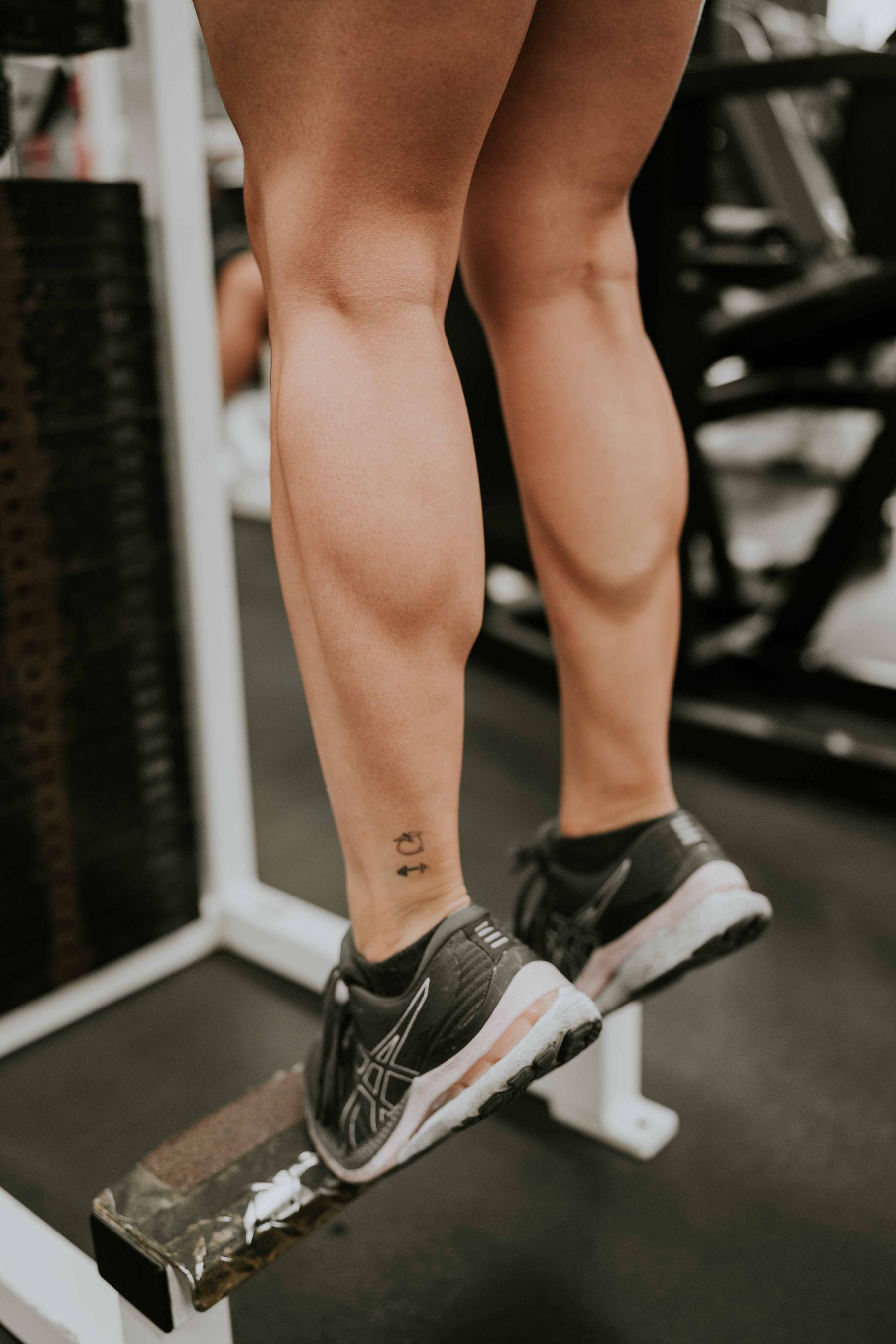
Heavy, slow calf work is the engine of Achilles recovery — the tendon rebuilds capacity in response to load.
What does the research say about Achilles treatment?
Exercise that progressively loads the tendon is the foundation of Achilles tendinopathy care. A living systematic review with network meta-analysis of 29 randomized trials in the British Journal of Sports Medicine concluded that calf exercise programs are the core evidence-based treatment, and found no add-on therapy clearly superior to exercise alone.[2] A landmark randomized trial comparing the two main loading styles — the classic Alfredson eccentric heel-drop program and heavy slow resistance training three times per week — found both produced significant, lasting improvement at one year, with heavy slow resistance earning higher patient satisfaction at 12 weeks.[3]
A 2019 systematic review of loading programs reached a practical conclusion: multiple loading approaches improve pain and function, and no single protocol is decisively best — so the program should fit your schedule, equipment, and irritability level, because the one you actually complete is the one that works.[4] What doesn't hold up as a fix on its own: rest, ice, and passive modalities. They may calm a flare, but they don't restore the tendon's load capacity — and capacity is the problem.
How we treat Achilles tendinopathy at RISE
Achilles care at RISE is a coached loading program wrapped around your real training week — not a printout and a hot pack. Every session is 45 minutes one-on-one with the same Doctor of Physical Therapy.
Location and stage diagnosis: midportion vs. insertional changes the exercises; irritability sets the starting dose.
Calf capacity testing: single-leg heel-raise capacity and strength are measured, giving a baseline your progress is tracked against.
Progressive loading: a 12-week-plus program of heavy, slow calf work, progressed by numbers rather than guesswork.
Running and activity math: volume, hills, and pace get adjusted so you keep training while the tendon rebuilds — with a clear pain-monitoring rule.
Heel-raise testing, palpation, and load history establish where the tendon is — and how far it needs to go.
02 — TREAT
Settle and start loading
Isometrics and dose-controlled calf work begin rebuilding tolerance while daily-life aggravators get modified.
03 — REBUILD
Return to speed
Heavy slow resistance progresses into energy-storage work — hopping, hills, pace — until running feels springy again.
What to expect at your first visit
Your story first. When the tendon started talking, what changed in training — mileage, hills, shoes, surfaces — and what you're trying to get back to.
A hands-on exam. Palpation to locate midportion vs. insertional pain, calf strength and heel-raise capacity testing, and screening for rupture risk and other heel-pain causes.
Your starting dose. You'll leave with the first exercises of your loading program, matched to irritability — usually beginning that day.
A training plan, not a shutdown. We map which runs, hikes, or workouts stay, which get modified, and the pain-monitoring rule that guides the next two weeks.
A realistic timeline. Tendons adapt over roughly 12 weeks and beyond — we set milestones so you can see the rebuild happening.
Frequently asked questions
What is the fastest way to fix Achilles tendinopathy?+
There is no honest shortcut — the treatment with the strongest evidence is progressive tendon loading over about 12 weeks, using either eccentric heel-lowering exercise or heavy slow resistance training. A randomized trial found both produce good, lasting results, with heavy slow resistance showing better patient satisfaction at 12 weeks.[3] Passive treatments alone (rest, ice, ultrasound) don't rebuild the tendon's capacity.
Should I stop running with Achilles pain?+
Usually not completely. Tendons tolerate — and need — load during recovery, so we typically modify volume, speed, and hills rather than prescribe rest, using a simple pain-monitoring rule: mild pain that settles within 24 hours is generally acceptable, while sharp or worsening pain means the dose was too high. Complete rest often makes a tendon less tolerant, not more.
Will my Achilles tendon rupture if I keep exercising?+
Tendinopathy pain itself is not a sign of impending rupture, and structured loading is the standard, evidence-based treatment — not a risk factor. That said, sudden sharp calf pain with a pop, a feeling of being kicked, or new inability to push off deserves urgent assessment. A graded program supervised by a physical therapist is designed to stay well inside the tendon's tolerance.
Why does my Achilles hurt most in the morning?+
Morning stiffness is a signature of Achilles tendinopathy. Overnight the tendon rests in a shortened position, and irritated tendon tissue stiffens; the first steps stretch it under body weight before it has warmed up. As collagen and fluid dynamics normalize with loading treatment, that first-step pain is usually one of the first symptoms to improve.
Do I need a referral for Achilles treatment in Idaho?+
No. Idaho is a direct-access state, so you can book an Achilles evaluation at RISE without a physician referral. Some insurance plans — commonly Medicare, Medicaid, and Tricare — require a referral for coverage, and we'll verify your plan's requirements before your first visit.
Does insurance cover physical therapy for Achilles tendinopathy?+
Most major medical plans cover physical therapy for Achilles tendinopathy. RISE is in-network with most major insurance plans in Idaho — check our insurance list or contact us and we'll verify your coverage before your first appointment.
Carson is a co-founder of RISE Physical Therapy and treats orthopedic, sports, and foot & ankle conditions with a hands-on, movement-first approach. He earned his Doctorate of Physical Therapy from Pacific University in Oregon. Meet the full team →
SOURCES
de Jonge S, et al. Incidence of Midportion Achilles Tendinopathy in the General Population. British Journal of Sports Medicine, 2011. pubmed.ncbi.nlm.nih.gov/21926076
van der Vlist AC, et al. Which Treatment Is Most Effective for Patients With Achilles Tendinopathy? A Living Systematic Review With Network Meta-analysis of 29 Randomised Controlled Trials. British Journal of Sports Medicine, 2021. pubmed.ncbi.nlm.nih.gov/32522732
Beyer R, et al. Heavy Slow Resistance Versus Eccentric Training as Treatment for Achilles Tendinopathy: A Randomized Controlled Trial. American Journal of Sports Medicine, 2015. pubmed.ncbi.nlm.nih.gov/26018970
Head J, et al. The Efficacy of Loading Programmes for Improving Patient-Reported Outcomes in Chronic Midportion Achilles Tendinopathy: A Systematic Review. Musculoskeletal Care, 2019. pubmed.ncbi.nlm.nih.gov/31763774
 Medically reviewed by Dr. Carson Bailey, PT, DPT · August 2026