Reaching the top shelf, throwing to the dog, sleeping on your side — when the rotator cuff is unhappy, everything overhead has a toll. Most cuffs recover without surgery.
The rotator cuff is the set of four tendons that steer and stabilize the shoulder, and it's the most common source of adult shoulder pain — from tendinopathy to full-thickness tears. Structured physical therapy resolves symptoms for roughly 75% of patients with atraumatic full-thickness tears, making exercise first-line care for most cuff problems. RISE Physical Therapy treats rotator cuff pain one-on-one in 45-minute sessions in Boise and Nampa, Idaho, with no referral required.
What is the rotator cuff — and what goes wrong?
The rotator cuff is four muscles — supraspinatus, infraspinatus, teres minor, and subscapularis — whose tendons wrap the ball of the shoulder like a cuff on a sleeve. Their job is less about big lifting and more about steering: holding the ball centered in the socket while the bigger muscles move the arm. When the cuff can't keep up, tendons get pinched and overloaded, and pain follows.
The spectrum runs from irritated but intact tendons (tendinopathy, the most common), to partial-thickness fraying, to full-thickness tears. Two facts keep that spectrum in perspective: cuff changes are partly a normal feature of ageing tendon — many adults over 50 have tears on imaging with zero pain — and pain correlates poorly with tear size. That's why treatment decisions ride on your strength, function, and history rather than the picture alone.
Symptoms: when should you seek help?
Cuff problems announce themselves in predictable ways. Book an evaluation if you notice:
Pain on the outside of the shoulder or upper arm with overhead reach
A painful arc — fine at the start of the motion, sharp in the middle, easier at the top
Night pain, especially lying on the affected side
Weakness rotating the arm outward or lifting it to the side
Pain with reaching behind you — a seatbelt, a back pocket, a bra strap
A sudden inability to lift the arm after a fall or forceful pull deserves prompt medical evaluation — acute traumatic tears are the group where earlier surgical opinions genuinely matter.
Cuff pain typically flares with overhead reach and at night — and responds to progressive, targeted loading.
Do rotator cuff tears need surgery?
Less often than most people assume. In the multicenter MOON Shoulder Group cohort of patients with atraumatic, full-thickness cuff tears, a structured physical therapy program was effective for approximately 75% of patients at 2 years — meaning they improved enough to decline surgery — with benefits maintained at longer follow-up.[1][2] A systematic review of exercise therapy for full-thickness tears likewise supports conservative management as a credible first option.[3]
The honest boundaries: rehab doesn't reattach a torn tendon, and outcomes are less predictable for large, traumatic, or profoundly weak shoulders — those deserve a surgical consult early. For the far more common degenerative tear and for tendinopathy, a genuine 3–6 month progressive loading program is the evidence-backed first move, with surgery as the fallback rather than the default.
How we treat rotator cuff pain at RISE
Shoulders are steering problems as much as strength problems. Every RISE session is 45 minutes one-on-one with the same Doctor of Physical Therapy — time to retrain the whole system, not just hand you a band.
Neck-and-shoulder exam: cervical referral mimics cuff pain often enough that we test both before naming the problem.
Graded cuff loading: progressive rotation and elevation strengthening — the intervention with the strongest evidence base for cuff recovery.
Scapular mechanics: the shoulder blade is the cuff's foundation; we rebuild its control so the tendon stops getting pinched.
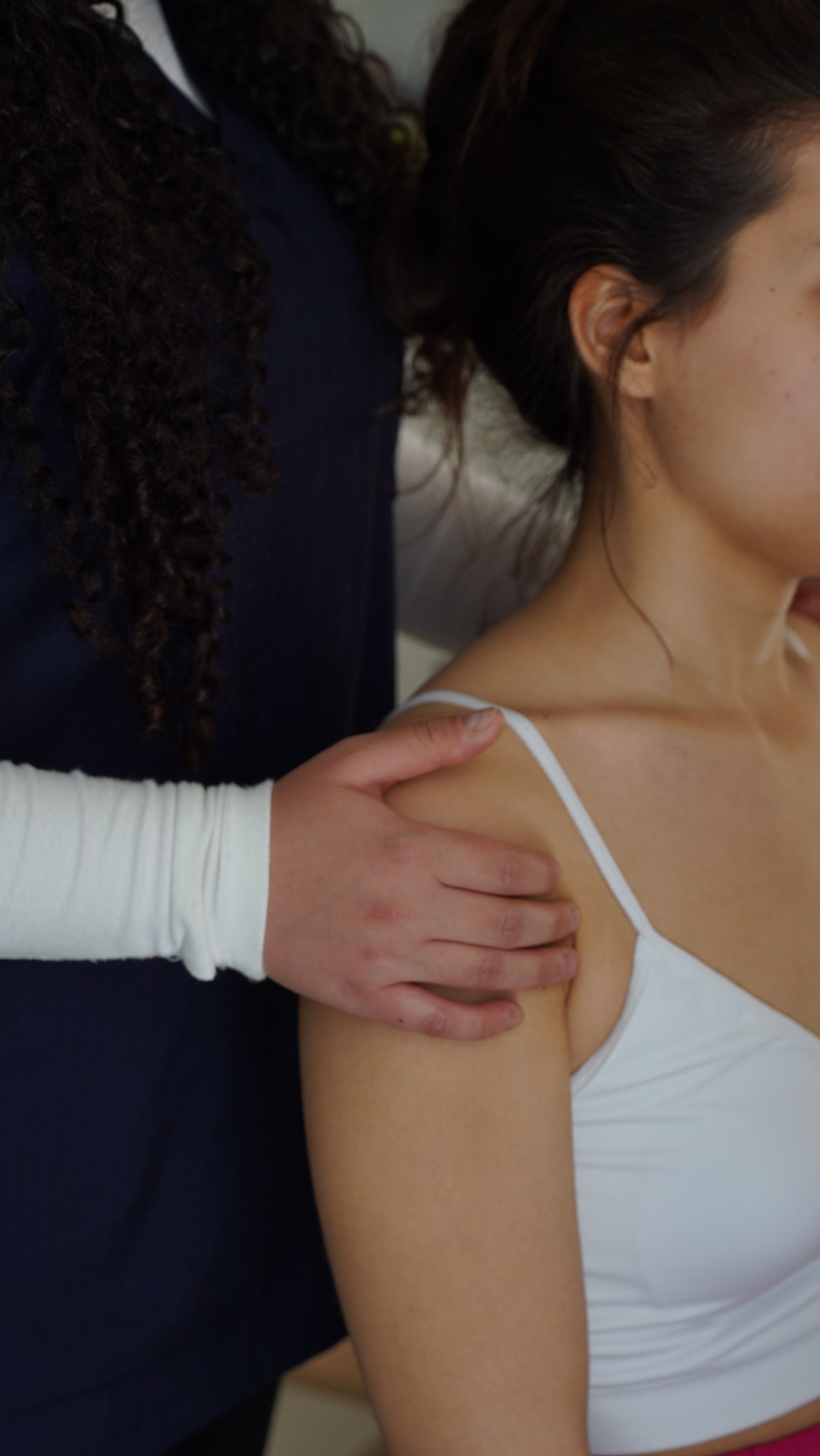
Symptom relief that keeps you training: manual therapy, dry needling to the cuff and upper trap, and night-positioning fixes for sleep.
Strength, range, painful arc, and cervical screening establish what structure is driving symptoms.
02 — TREAT
Calm and correct
Hands-on care settles the irritated tendon while early loading and scapular work start immediately.
03 — REBUILD
Earn overhead back
Progressive cuff strengthening returns reaching, lifting, and sleeping — measured, not assumed.
What to expect at your first visit
Your story first. How it started, what movements and positions hurt, how it's affecting sleep, work, and training.
A structured exam. Strength testing by muscle, painful arc assessment, and a neck screen to rule out referral.
Honest triage. If your presentation suggests a surgical consult is warranted, we say so at visit one — not visit ten.
Treatment on day one. Hands-on work plus the first two or three exercises of your loading program, dosed to your irritability.
Sleep fixes now. Positioning strategies that improve night pain this week, while the program fixes the cause.
Frequently asked questions
Can a rotator cuff tear heal without surgery?+
The tear itself doesn't knit back together, but that's not the goal — pain-free function is. In the multicenter MOON Shoulder cohort, a structured physical therapy program was effective for roughly 75% of patients with atraumatic full-thickness tears at 2 years, with results holding in longer follow-up.[1] Many pain-free adults have cuff tears on imaging; the tendon that remains can be trained to do the job.
How do I know if my shoulder pain is the rotator cuff?+
Classic rotator cuff signs are pain with overhead reach, a painful arc in the middle of the motion, pain lying on that side at night, and weakness with rotation or lifting away from the body. Neck problems, the AC joint, and frozen shoulder can mimic it, which is why the evaluation tests your neck and shoulder together before naming the culprit.
Do I need an MRI before starting physical therapy for my shoulder?+
Usually not. Rotator cuff changes appear on MRIs of many pain-free adults, so imaging alone can't say why your shoulder hurts — and the first-line treatment for most atraumatic cuff pain is a progressive exercise program either way. Imaging becomes important after significant trauma, with substantial weakness, or when quality conservative care isn't working.
Do I need a referral for shoulder physical therapy in Idaho?+
No. Idaho is a direct-access state, so you can book a shoulder evaluation at RISE without a physician referral. Some insurance plans — commonly Medicare, Medicaid, and Tricare — require a referral for coverage, and we'll verify your plan's requirements before your first visit.
When does a rotator cuff tear need surgery?+
Surgery moves up the list for acute, traumatic tears in younger or high-demand patients, substantial weakness from a large tear, and shoulders that fail a genuine 3–6 month course of structured rehab. If your exam suggests you're in one of those groups, we say so early and coordinate with a surgeon — and quality rehab beforehand doesn't burn the surgical bridge.
Why does my shoulder hurt more at night?+
Lying down removes gravity's traction on the arm and compresses the irritated cuff and bursa between the humerus and the shoulder blade — especially side-lying. Night pain is one of the most common and most fixable rotator cuff complaints; positioning changes help quickly while the strengthening program addresses the cause.
Does insurance cover physical therapy for rotator cuff injuries?+
Most major medical plans cover physical therapy for rotator cuff conditions, both non-operative care and post-surgical rehab. RISE is in-network with most major insurance plans in Idaho — check our insurance list or contact us and we'll verify your coverage before your first appointment.
Devon is a co-founder of RISE Physical Therapy and treats orthopedic, sports, post-surgical, concussion, and TMJ injuries. He earned his Doctorate of Physical Therapy at Idaho State University. Meet the full team →
SOURCES
Effectiveness of Physical Therapy in Treating Atraumatic Full-Thickness Rotator Cuff Tears: A Multicenter Prospective Cohort Study (MOON Shoulder Group). Journal of Shoulder and Elbow Surgery, 2013. sciencedirect.com/science/article/abs/pii/S1058274613000839
Nonoperative Treatment of Atraumatic, Symptomatic, Full-Thickness Rotator Cuff Tears: Five-Year Follow-Up of the MOON Shoulder Group Cohort. Journal of Shoulder and Elbow Surgery, 2018. jshoulderelbow.org/article/S1058-2746(18)30852-8
Exercise Therapy for the Conservative Management of Full Thickness Tears of the Rotator Cuff: A Systematic Review. British Journal of Sports Medicine, 2007. pubmed.ncbi.nlm.nih.gov/17264144
 Medically reviewed by Dr. Devon Hoffman, PT, DPT, CSCS · August 2026